Bremsen in Elektroautos stecken voller Technik
![elektroautos-bremsen[1]](/techworld/assetsfs/images/elektroautos_bremsen_1_1_customresolution.jpg)
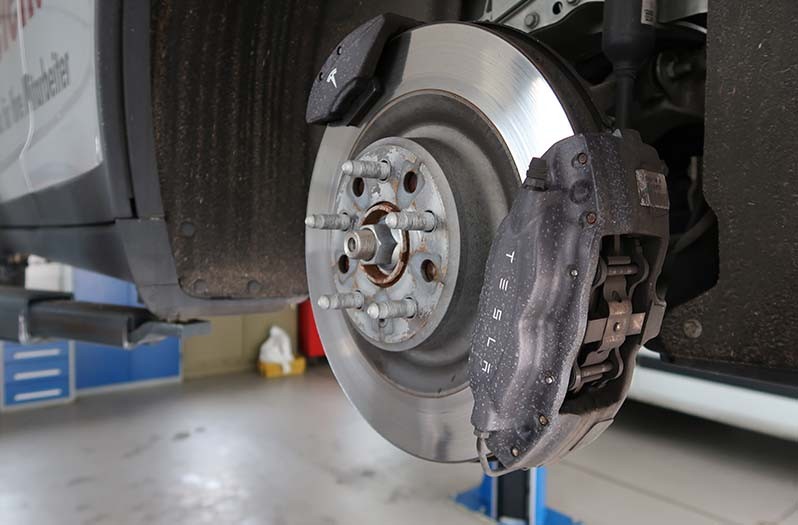
Elektro-Autos stellen besondere Anforderungen an die Bremsanlage. Die Fahrzeuge sind aufgrund der Batterien schwerer, die Drehmomente sind höher, die Beschleunigung stärker. Dies verursacht beim Bremsvorgang einen erhöhten Verschleiß der Bremsscheiben und Beläge – müsste man meinen. Einerseits ja, doch die mechanischen Bremsen werden im Vergleich zu Autos mit Verbrennungsmotor systembedingt deutlich weniger betätigt. Stichwort: Regeneratives Bremsen. Die Verzögerung des E-Fahrzeugs wird je nach Betriebssituation über die Generatorfunktion der E-Maschine(n) durch Energie-Rückgewinnung (Rekuperation) bewerkstelligt oder zumindest anteilig unterstützt. Experten sprechen bei Elektroautos von rund einem Fünftel weniger Bremseingriffen. Die Bremsbeläge sind also keinem erhöhten Verschleiß ausgesetzt. Im Gegenteil: Da die beiden Reibpartner, die Bremsbeläge und die Bremsscheibe nicht permanent beansprucht werden, altern Beläge tendenziell rascher und können verglasen. Bei Bremsscheiben kann es zur Rostbildung kommen. Die Folge sind materialbedingte Vibrationen und Geräuschemissionen wie Quietschen oder Schleifen.
Ein interessanter Punkt, rücken derartige Geräusche doch speziell bei E-Autos aufgrund der leisen E-Maschine in den Vordergrund und beeinträchtigen so den akustischen Fahrkomfort. Zudem kann die Bremsperformance nachlassen, wenn man scharf in die ‚Eisen‘ steigen muss. „Die geringere Nutzung der herkömmlichen Bremsen kann bei E-Autos zu Problemen führen“, so Jannis Dörhöfer, Referent für New Mobility beim deutschen TÜV-Verband. „Werden die Bremsbeläge nicht ausreichend und regelmäßig erhitzt, können die Materialeigenschaften leiden.“ Die Folge seien eine Absenkung des Reibwertes und somit eine schlechtere Bremswirkung. „Eine regelmäßige Kontrolle und Wartung der Bremsanlage ist also bei Elektrofahrzeugen zu empfehlen.“br /> Aus diesen Gründen hat HELLA spezielle Bremsbeläge und Bremsscheiben für Elektrofahrzeuge im Programm. Sie sind eigens für diese besonderen Rahmenbedingungen ausgelegt und gewährleisten die Bremsleistung und den Bremskomfort trotz ‚Ruhepausen‘. Die Marktabdeckung beläuft sich im Aftermarket aktuell bereits auf über 90 Prozent an Bremsbelägen für Elektro- und Hybridfahrzeuge sowie 85 Prozent an Bremsscheiben.

An electromechanical brake booster with pressure accumulator, an electric vacuum pump and the brake pedal value sensor play a central role. Depending on the requirement, i.e. depending on the brake pedal position and brake pedal pressure, the brake control unit calculates the necessary braking force in milliseconds. From approx. 0.25 g, the brake booster (depending on the vehicle and its settings) activates the mechanical brakes. In addition, there is the intelligent control of ABS and ESP and the integration of driver assistance systems, such as the emergency brake assistant. The advantage: the dual brake system (brake blending = mixed brake control) can be controlled extremely accurately and the brake intervention is always optimally dosed. So, it all interacts perfectly!
HELLA is a specialist in vacuum pumps and electronic brake pedals, and in the appropriate sensor technology. The pedal feel can even be regulated dynamically by hydraulic valves or damping units (simulators)
Electric cars: special brake pads, special brake discs
Basically, at first glance there are no differences between brake pads and brake discs for combustion and electric cars. The layout is similar. But the vehicle manufacturers are constantly adapting the specifications for e-cars. In the case of brake pads, the focus is on quiet and low-vibration pads (Noise, Vibration, Harshness - NVH). Sometimes the brake pads even have a "slimmer" design: they have a smaller and thinner friction surface, which is caused by the lower frequency of use. Material can also be saved, which benefits the environment.
When it comes to product development, HELLA focuses on environmental protection and environmental compatibility in addition to achieving optimal performance of the product. The brake pads for electric and hybrid vehicles, for example, are all copper-free. The brake pads' copper-free formula is not only environmentally friendly, but has also been designed precisely for the relevant vehicle types, brake systems, engine performance, driving loads and braking characteristics. They have a higher compressibility and tend to have higher coefficients of friction. As a result of the lower frequency of use, the brake pads must also function optimally when cold. HELLA tests all properties regarding the coefficient of friction, pedal pressure and heat wear. The brake pads also exceed the current requirements set out in the ECE R90 regulation.
HELLA offers heavy-duty, high-carbon brake discs, specially for very powerful electric and hybrid vehicles. The increased carbon content enables rapid heat dissipation even in extreme situations, which also enables optimum braking performance. The brake discs also ensure low fading behaviour, reduced braking noise, less warping and increased braking comfort. In order to prevent corrosion, the brake discs are coated with a water-based paint. And what's more, they can be installed immediately in the workshop: no protective oil needs to be removed
Euro 7 and brake dust emissions in electric cars: new test procedure
With the introduction of the new Euro 7 exhaust gas regulation from 2025, manufacturers of passenger car brake pads must also record particulate emissions and comply with the relevant values. This regulation is to apply to vehicles with internal combustion engines and to electric and hybrid vehicles. The central aspect here is the interaction between the friction partners – the "pad" and the "disc". It strongly depends on the material composition and their dynamic interaction over the brake components' life cycle. So as to reduce this particulate matter, HELLA is relying on environmentally compatible brake pad compounds.
The measurement of emissions itself is not a simple undertaking, especially since the measured values must be reproducible and comparable. To ensure that the measurement results can be transferred to real-world driving conditions, a uniform WLTP (Worldwide Harmonised Light Vehicles Test Procedure) was developed. This cycle was defined using real vehicle data and it maps various brake operating points over a longer period of time. This ensures a reproducible recording of the brake abrasion. Going forward, braking emissions are to be measured uniformly on test benches using the WLTP braking cycle. Furthermore, it is crucial to accurately map the specific vehicle model on the test bench. For example, the combination of brake pad and brake disc, and the vehicle weight and weight distribution influence the wear behaviour
Conclusion: Brakes in electric cars – pretty good!
In conclusion, it can be said that electric cars themselves produce significantly fewer emissions. This means not only the complete elimination of exhaust gases from the engine, but also lower noise development and significantly lower brake dust emissions related to the system, thanks to proportional brake energy recovery (recuperation). Quiet acceleration, quiet braking, pretty good