Compressibility | HELLA
In many publications dealing with the ECE-R90 test, the word compressibility appears.
But what does this really mean?
The compressibility of a brake lining refers to the degree that a brake lining can be "pressed together"; in other words, tests are run to see how much the brake lining strength alters when subjected to pressure. This is measured in µm. A μm is one thousandth of a mm.
Illustration of a testing procedure:
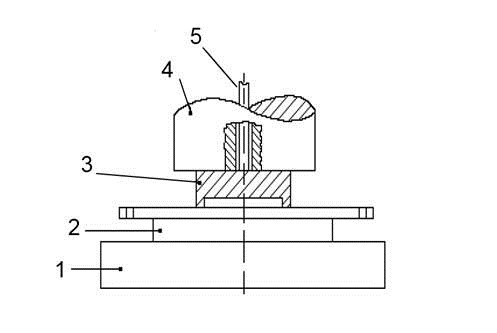
The brake lining ( 2 ) is laid, friction side down, on a solid, polished and heated steel plate ( 1 ). By means of a piston adapter ( 3 ) which corresponds to the type of piston used in the brake itself, the measuring piston of the testing device ( 4 ) presses the brake lining together. The force with which the lining is pressed together corresponds to a braking pressure of 160 bar. A distance sensor ( 5 ) measures how much i.e. how far, the lining can be pressed together. The measurements are carried out at room temperature and when the steel plate is heated to 400°C. The difference to the thickness of the lining can amount to a maximum of 2% at room temperature and a maximum of 5% at a temperature of 400°C.
Diagram:
The brake lining ( 2 ) is laid, friction side down, on a solid, polished and heated steel plate ( 1 ). By means of a piston adapter ( 3 ) which corresponds to the type of piston used in the brake itself, the measuring piston of the testing device ( 4 ) presses the brake lining together. The force with which the lining is pressed together corresponds to a braking pressure of 160 bar. A distance sensor ( 5 ) measures how much i.e. how far, the lining can be pressed together. The measurements are carried out at room temperature and when the steel plate is heated to 400°C. The difference to the thickness of the lining can amount to a maximum of 2% at room temperature and a maximum of 5% at a temperature of 400°C.