Brake disks | HELLA
General information
Since the introduction of the disk braking system to the automobile, it has become a key structural component in automotive engineering.
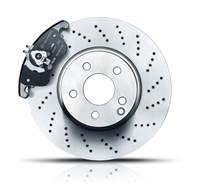
Material
Brake disks are exposed to heavy mechanical loads under braking. In addition to compressive forces, tensile forces and centrifugal forces, they must also withstand thermal loads. In order to achieve the best possible results in every braking situation, the material compositions of the brake disk and brake lining must be ideally compatible. Depending on the vehicle type and the application, brake disks can be made of grey cast iron, stainless steel, carbon or ceramic materials. The majority are made of grey cast iron, whose properties are improved by adding a wide range of materials. Admixing molybdenum and chromium improves the heat crack properties and the abrasion resistance of the alloy. Thermal absorption is improved by increasing the carbon content.
These brake disks, however, require special brake linings to compensate for their poorer thermal conductivity.
Designs
When braking, friction causes the kinetic energy to be converted into heat energy. Up to 90% of this converted energy is absorbed by the brake disk and released to the ambient air.
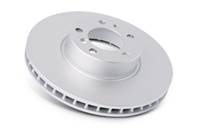
In addition, solid and ventilated brake disks may feature slits and grooves or be axially perforated. Brake abrasion, water and dirt collect in the slits or grooves and are discharged outward by the rotational movement. The axial holes increase heat dissipation but have no self-cleaning effect, because brake abrasion may be deposited in them.
Fig. 1
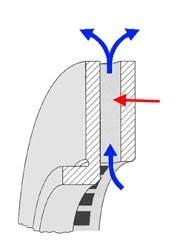
In addition, solid and ventilated brake disks may feature slits and grooves or be axially perforated. Brake abrasion, water and dirt collect in the slits or grooves and are discharged outward by the rotational movement. The axial holes increase heat dissipation but have no self-cleaning effect, because brake abrasion may be deposited in them.
Variants
Depending on the vehicle or brake system design, brake disks installed on the rear axle of a vehicle may also feature an integrated brake drum for the handbrake mechanism in the brake disk chamber.
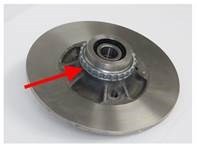
Some manufacturers also integrate wheel bearing and pulse rings for the antilock system (fig. 3) in their brake disks. Both designs demand a high degree of care by technicians when performing repairs. Brake disks are partly coated to improve their corrosion resistance. These brake disks can be coated with an anti-rust finish completely or outside the friction ring. At the same time, the visual effect is improved in the exposed rim area of the wheel brake. If the brake disk is completely coated, a moderate running-in period is recommended until the brake lining and the disk have adapted to one other and the paint coat on the friction ring has detached due to friction.
In addition, solid and ventilated brake disks may feature slits and grooves or be axially perforated. Brake abrasion, water and dirt collect in the slits or grooves and are discharged outward by the rotational movement. The axial holes increase heat dissipation but have no self-cleaning effect, because brake abrasion may be deposited in them.
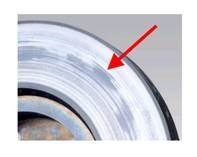
Brake judder
This is a low-frequency vibration in the vehicle caused by braking.
A distinction is made between cold and hot judder.
In addition, solid and ventilated brake disks may feature slits and grooves or be axially perforated. Brake abrasion, water and dirt collect in the slits or grooves and are discharged outward by the rotational movement. The axial holes increase heat dissipation but have no self-cleaning effect, because brake abrasion may be deposited in them.
Wear and testing
Brake disks are subject to natural wear and tear due to high mechanical and thermal loads and additional environmental impact. The state of the brake system should therefore be regularly checked at the servicing intervals recommended by the manufacturer. The wear limit of the brake disk is set by the manufacturer as a minimum thickness of the friction ring. This value, in millimetres, is stated or stamped on the rim (fig. 5) of the brake disk. The value is calculated so that on reaching this thickness, under normal driving conditions and taking into account the previous brake lining service intervals, another set of brake linings can be installed. If the garage does not have any information on this, it is advisable to replace the brake disks and linings.
Additional tests include concentricity (lateral runout), and thickness difference (differing disk thicknesses) in the brake disk.
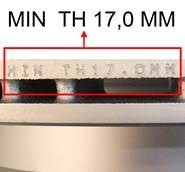
Fig. 5
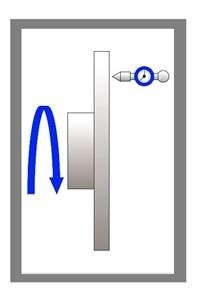
Fig. 6
Maintenance information
The measurement of thickness difference in the friction ring of a brake disk can only be precisely carried out with special equipment. A micrometre calliper, however, also provides sufficient measuring accuracy of ± 0.001 mm. Measurement should be carried out at 12 to 15 positions on the circumference of the disk and approx. 10 to 15 mm below the outer friction radius. Depending on the vehicle type, thickness differences of 0.012 mm to 0.015 mm can already cause judder phenomena. As a result, these values must not be undercut on new brake disks.