How the 77 GHz radar sensor works and why it is indispensable for modern ADAS
Key facts at a glance
- 77 GHz radar technology – the crucial part in ADAS: Cutting-edge radar sensors enable reliable environment detection for functions including ACC, automatic emergency braking, lane change and cross-traffic assist – even in rainy, foggy and dark conditions.
- Compact design, rugged technology: The HELLA 77 GHz radar sensor combines RF-CMOS technology, integrated signal processing and self-diagnostics in a rugged housing for tough vehicle applications.
- FMCW principle for accurate measurements: Frequency-modulated continuous wave radar simultaneously and highly accurately detects the distance and relative speed of several objects.
- Versatile areas of application: From front radar to corner radar as well as parking, off-highway and autonomous applications – 77 GHz sensors offer flexible use.
- Crucial diagnostics and calibration: Vehicle-specific calibration using the diagnostic unit is essential to guarantee safe system functionality following its removal and installation, work on the vehicle's body or chassis.
Important safety information
The following technical information and practical tips have been compiled by HELLA in order to provide professional support to vehicle workshops in their day-to-day work. The information provided on this website is intended for use by suitably qualified personnel only.
Using 77 GHz radar sensors in cutting-edge driver assistance systems
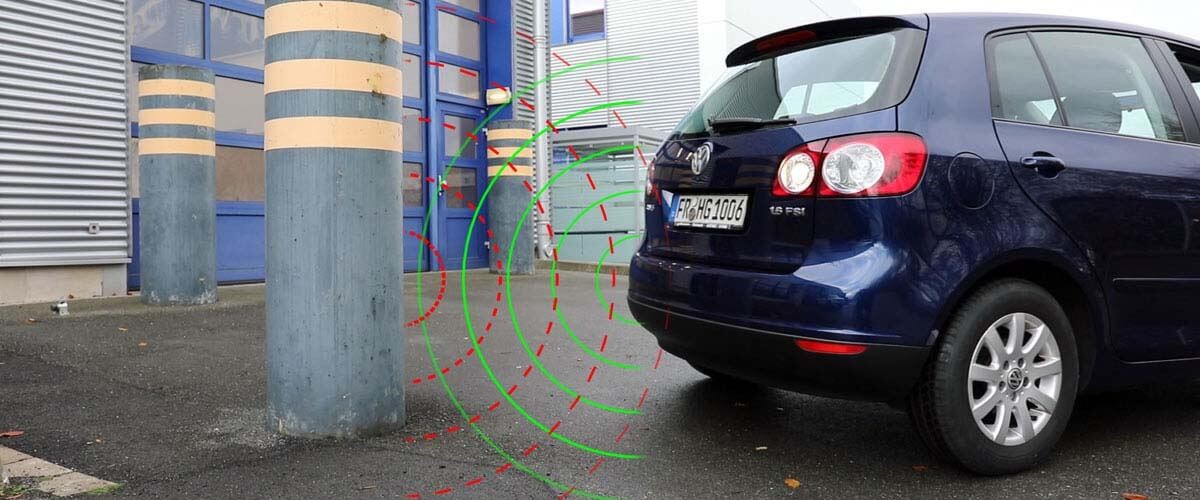
Radar sensors with various ranges are used in cutting-edge vehicle architectures to provide various driver assistance functions. Short-range radars (typically 24 GHz or 77 GHz with small antenna aperture) detect objects at close range and support parking assistance systems. Medium-range radars detect vehicles to the side and are used for lane change and cross-traffic assist systems. Long-range radars with a long range and narrow opening angle enable functions, such as adaptive cruise control (ACC) and automatic emergency braking. Thanks to their rugged performance in rainy, foggy and dark conditions, radar sensors provide accurate distance and relative speed measurements. Integrating them into camera and lidar systems enables sensor-fusion-based environment perception for highly automated driving functions.
Radar sensor frequency ranges in automotive applications
Radar sensors operating across various frequency ranges are used in a host of vehicles, depending on the respective application and range.
The following section provides an overview of the frequency ranges and their typical areas of application:
| Frequency range | Typical range | Area of application |
| 24 GHz (24.05 - 24.25 GHz) | Up to approx. 30 m | Parking aid, blind spot assistance systems |
| 77 GHz (76.0 - 77.0 GHz) | Up to approx. 250 m | Adaptive cruise control (ACC), lane change assistant, cross-traffic warning |
| 77.0 - 81.0 GHz | Up to approx. 300 m | High-resolution applications, automated driving, emergency braking, ACC |
HELLA 77 GHz radar sensor – design and functionality
Areas of application and technical properties
Application in ADAS and autonomous driving functions
HELLA 77 GHz radar sensors are designed for use in demanding environments and offer high-resolution detection capability. They are suitable for operation in on-highway and off-highway vehicles and, depending on the sensor type, comply with protection classes including IP 6K7 and IP X9K.
Typical areas of application:
- ADAS (Advanced Driver Assistance Systems): Front radar for automatic emergency braking, ACC (Adaptive Cruise Control), collision avoidance
- Corner radar: for blind spot monitoring systems, lane change assistants, cross-traffic detection systems
- Parking and manoeuvring aids: accurately detect obstacles at low speeds
- Autonomous systems: Environment sensor systems for navigation and object classification
- Specialised vehicles: Agricultural and forestry equipment, construction machinery, mobile robots
System integration and diagnostics
Note on radar sensor calibration!
In certain vehicle models, the radar sensor holder is fixed and does not allow mechanical adjustment. Instead, fine adjustments are made electronically using the diagnostics system. In this process, it determines a correction angle and stores it in the control unit to safeguard correct functionality.
Radar sensor calibration is necessary if:
- The installation position of the sensor has been changed as a result of work on the vehicle body
- The radar sensor has been removed, installed or replaced
- The vehicle level has been changed as a result of a chassis modification or repair
- An adjustment error has been stored in the fault memory
Maintenance and repair instructions
Observe the following instructions during maintenance and repair to ensure that driver assistance systems featuring radar sensors operate properly:
- Exclusively trained specialists are permitted to carry out repair and maintenance.
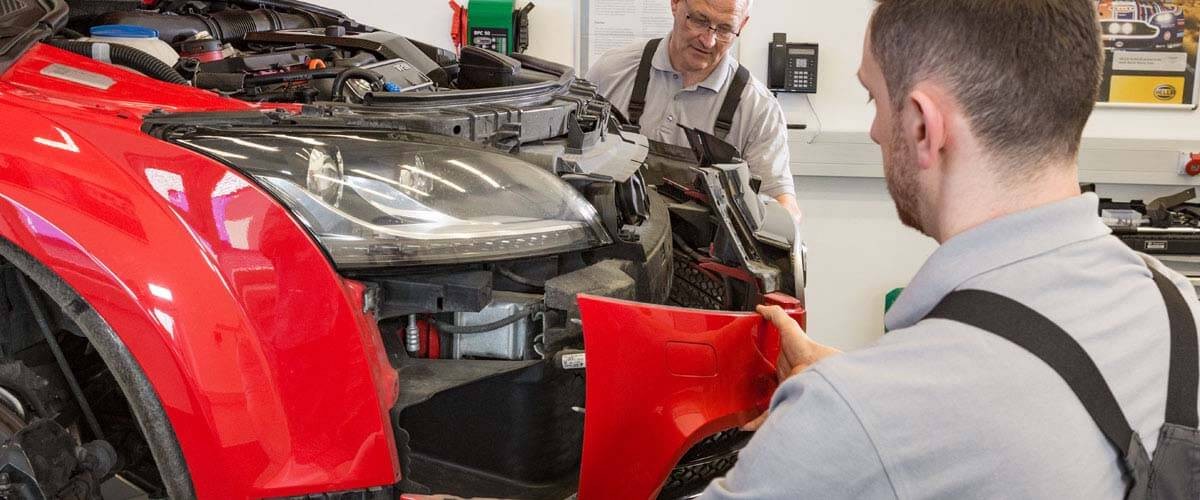
- After installation of the radar sensor, it may be necessary to carry out a vehicle-specific adjustment and also a system calibration by using a suitable diagnostic device.
- Bumper panelling must exclusively be repainted in compliance with the painting instructions specified by the vehicle manufacturer.
- Do not attach stickers to bumper panelling within the radar sensor transmission range.
- Work on hybrid and electric vehicles may only be carried out by persons who have been instructed in electrical engineering and who are appropriately qualified.
- Improper handling can lead to life-threatening situations.
In this context, it is essential to observe removal, installation and safety instructions of the respective vehicle manufacturer and the respective country-specific laws and regulations regarding work on high-voltage systems!
Further information on driver assistance system maintenance and repair is available on the following pages that deal individually with particular topics:
Lane change assistant | HELLA
Adaptive Cruise Control – adjusting sensor | HELLA
Important!
Exemplary representations, pictures and descriptions serve to explain and illustrate the document text and cannot be used as a basis for vehicle-specific repairs.
How helpful is this article for you?
Success
Success
Success
Success
Error
Please tell us what you did not like.
Thank you for your feedback!
Wrong Captcha
Something went wrong
Further technical information