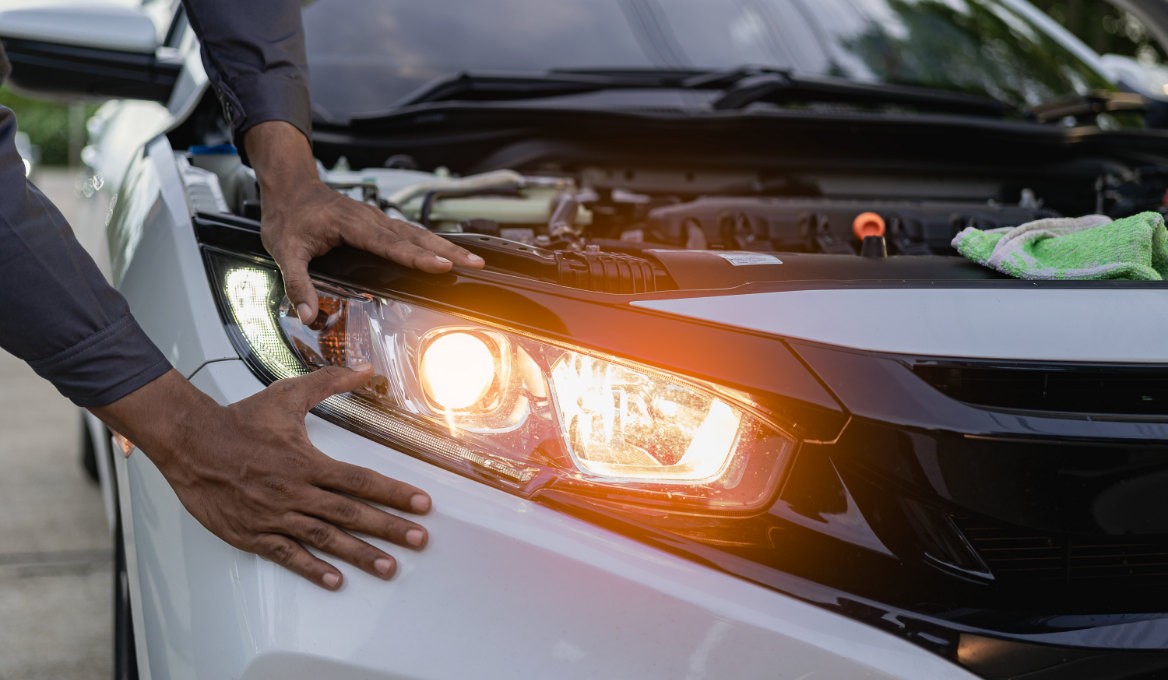
CAN bus and vehicle lighting: what workshops need to know when replacing bulbs
In the past, automotive lighting was simply about emitting light – today the lighting system forms part of a digital network. This comes as a result of modern vehicles communicating by what is known as the CAN bus (Controller Area Network). Vehicle lighting has also been integrated into this system: the vehicle electric system control unit monitors lighting circuits and reports via the CAN bus if a bulb is faulty or the current consumption deviates from the set value. For workshops this means: Replacing bulbs requires a technical understanding to avoid error messages, flickering or complaints.
What does the CAN bus do in terms of vehicle lighting?
The CAN bus is the communication network in modern vehicles. Control units use it to permanently exchange information. Lighting has also been integrated into this system. Control units monitor each bulb for current flow and resistance. They know the exact setpoint of the genuine bulb and expect a certain power consumption.
Many vehicle electric system control units can identify even minor deviations – and hence even new, operational bulbs may be reported as being faulty. This is usually caused by a deviating electrical load, for example when retrofitting LED bulbs to replace halogen bulbs.
The system incorrectly interprets the LED's lower electrical energy consumption as an interruption. It reacts as if the bulb had burnt out. Workshops are then often faced with irritated customers, even though everything works as far as technology is concerned.
Typical sources of errors in everyday operations
Error messages following bulb replacements usually have an easy fix. The fault is often less to do with the vehicle than with the bulb itself.
Incompatible resistance values are one of the most common problems. Low-budget LED light sources, for example, feature electronics that merely simulate a bulb and are therefore not identified by the control unit. Low-quality adapters or loose contacts in the socket also lead to incorrect diagnoses.
Incorrect base plates or connectors that fail to establish full contact are equally problematic. Even very minor voltage deviations are enough to trigger an error message.
Operating different bulb types further increases the risk of error messages, for example if a halogen bulb is installed on one side of the vehicle and an LED version on the other. The control unit then identifies different loads and records this as a fault status.
The vehicle electric system control unit may also identify a faulty earth connection or corrosion in the bulb holder as a "bulb fault" – even though the bulb itself is working fine.
How workshops can avoid error messages
With a little care and technical background knowledge, you can reliably prevent CAN bus issues when you replace bulbs.
Firstly, always check whether the desired bulb is CAN bus-compatible. Such bulbs are equipped with additional electronic resistors or integrated decoders that simulate the typical electrical energy consumption of a conventional halogen bulb. This means the control unit correctly identifies the light source.
HELLA always recommends using genuine parts or high-quality, branded products. These are designed to work reliably in electrical monitoring systems and do not generate error messages.
When converting to LED lighting, it may be necessary to install load resistors or special CAN bus decoders. They balance out the current consumption and prevent flickering or warning messages from appearing on the on-board computer.
If an error message appears despite having correctly replaced the bulb, check the wiring first. Connectors, ground points and fuses are often the actual causes. Only once these components are fully operational should you consider the control unit as a potential source of an error.

Checklist: Bulb replacements and CAN bus
- Select CAN bus-compatible bulb
- Check base plates and contact surfaces
- Clean ground points
- Document fault memory before/after replacement
- Test components following installation
HELLA offers supporting technology – developed for modern vehicle electrical systems and tested for full CAN compatibility. The result: reliable lighting, spotless diagnoses and satisfied customers.