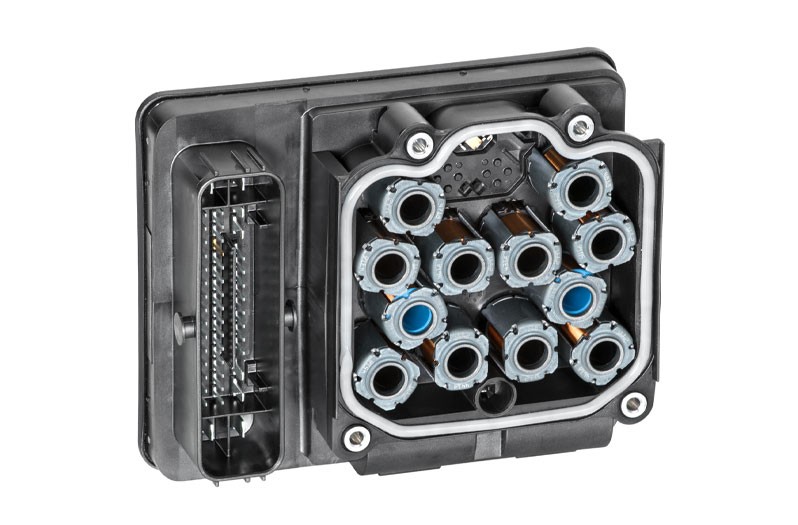
ABS/ESP control units for braking and driving dynamics

Important safety note

The following technical information and practical tips have been compiled by HELLA in order to provide professional support to vehicle workshops in their day-to-day work. The information provided on this website is intended for suitably qualified personnel only.

1. Basics

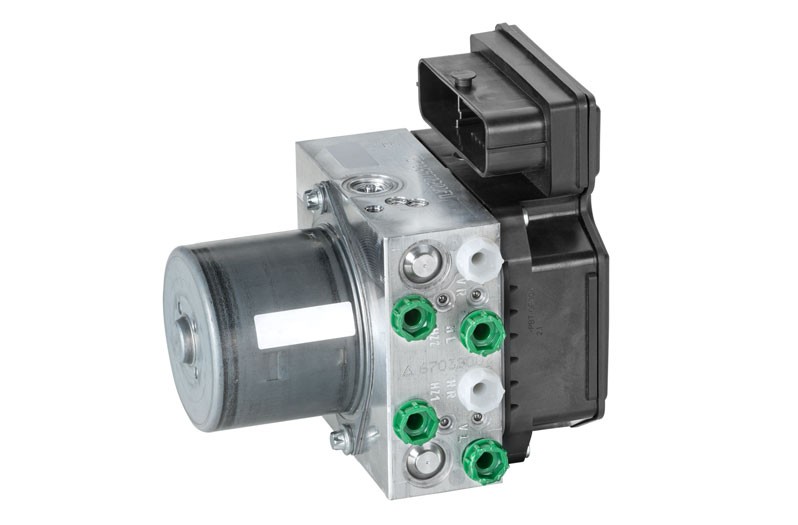
Brake system hydraulic unit with control unit for braking and driving dynamics

The hydraulic unit of the brake system with its control unit for braking and driving dynamics has become part of standard equipment in many vehicle models.

The Electronic Stability Programme (ESP) has the task of preventing lateral swerving when cornering or when faced with critical situations, e.g. during extreme driving manoeuvres. The system specifically intervenes in the braking system and in the engine and transmission management and keeps the vehicle on track. It is important that during such intervention physical laws cannot be overridden. As soon as the limits are exceeded, even the ESP system cannot prevent the vehicle from swerving.

As the number of vehicles equipped with ABS/ASR or ESP increases, not surprisingly the frequency of faults and the need for repairs in the workshop also increase.

Hydraulic unit of the brake system

The hydraulic unit contains the shift valves for the individual wheel brakes, which are necessary for the controlling of brake pressure. They are used in the hydraulic unit to control the 3 pressure states that require regulation: i.e. building up pressure, maintaining pressure, reducing pressure.
The hydraulic pump is used to generate the necessary admission pressure on the intake side of the return pump of the ABS system . The return pump is not able to build up the necessary initial pressure if the brake pedal is not depressed and there is no pressure present in the system.

Control unit for braking and driving dynamics

The control unit for braking and driving dynamics is usually fitted to the hydraulic unit.

The control unit consists of a powerful computer. So as to ensure the highest possible safety levels, the system consists of two computers with their own power supply and diagnostic interface, which use the same software. All information is processed in parallel and the computers monitor each other. The control unit is also responsible for controlling the ABS/ASR and the ESP. All systems are combined in one control unit.

2. Troubleshooting

Failure of ABS/ESP system

If the ABS/ESP system fails, this will be indicated by the control lamp lighting up permanently. A visual inspection should always be carried out in every case before complex and time-consuming diagnostics work is undertaken. During such inspection, particular attention should be paid to checking whether any leaks are present or whether components are damaged. If no abnormalities are detected during the visual inspection, a diagnostic unit is then used for further testing.

The ABS/ESP system has a self-diagnostic feature. This means it detects errors such as line interruptions, short circuits to earth(ground) or positive and also defects in the sensors. These errors can be stored in the error memory of the control unit and read. A diagnosis can be carried out on the ABS/ESP system with an appropriate diagnostic unit. Depending on the unit used, there is a wide range of testing possibilities available, checks which go as far as including a specially prescribed system test.

1

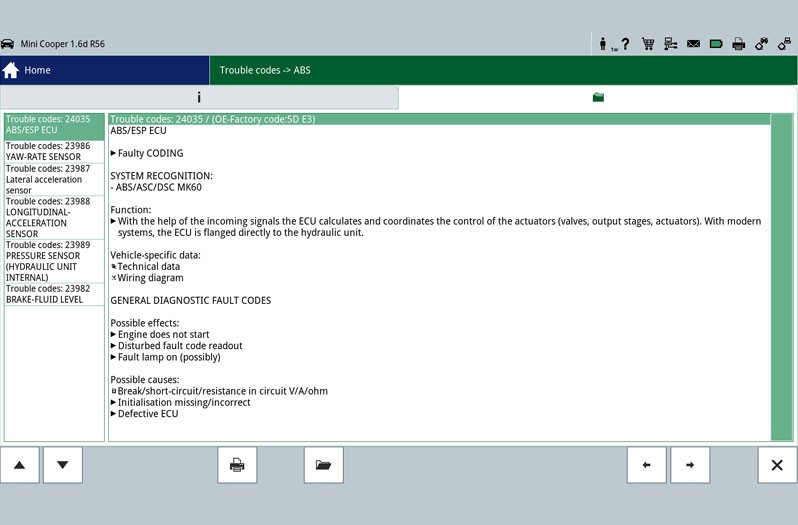
Reading the error memory

The first step is the reading out of the error memory. Any errors that occur are stored here and provide initial indications of the possible cause of the error. The stored error can give a direct indication about a defective component (Figure - Error memory 2) or about a short circuit/cable interruption. This allows targeted repair work to be carried out.
2

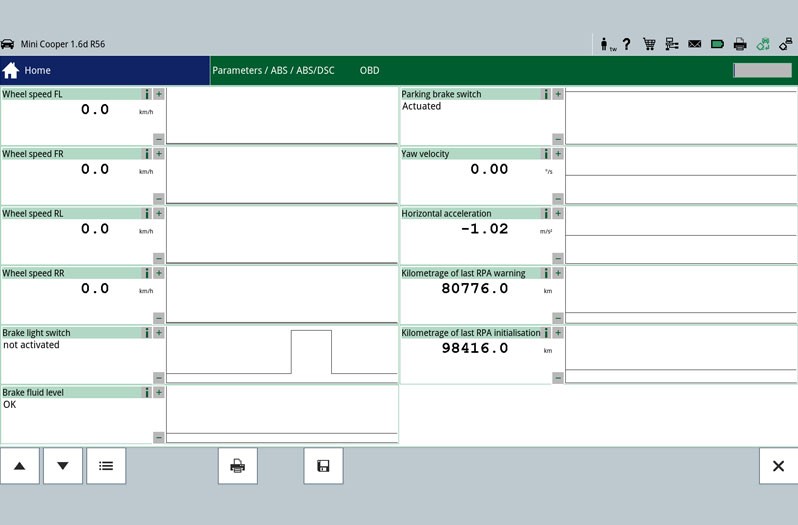
Reading parameters

If no errors are stored in the error memory, parameters can be read out and evaluated specifically with the aid of an actual value query. Technical documents with the required set points are necessary for the evaluating of the displayed actual values, unless these are stored in the diagnostic unit. Errors which are stored in the error memory are also displayed during the actual value query.

3

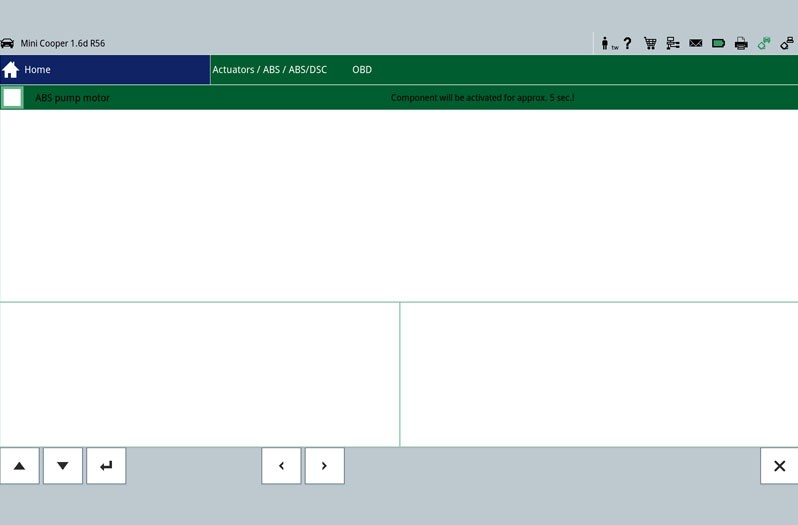
Actuator test

Another test option is the actuator test. During this test, individual components can be controlled by the diagnostic unit and thus their functioning checked.

4

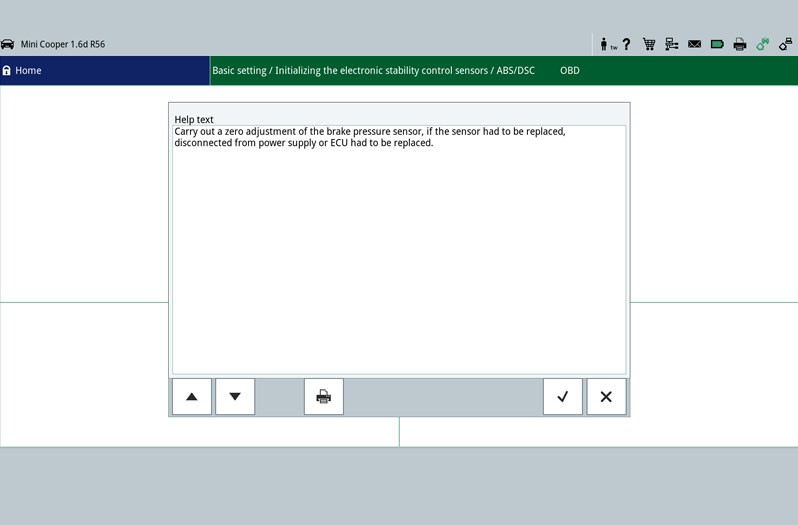
Basic setting

In this function, components, such as the sensors of the vehicle dynamics control system, can be set or adapted according to manufacturer values. The prerequisite for a basic setting is a vehicle system in perfect working order.

5

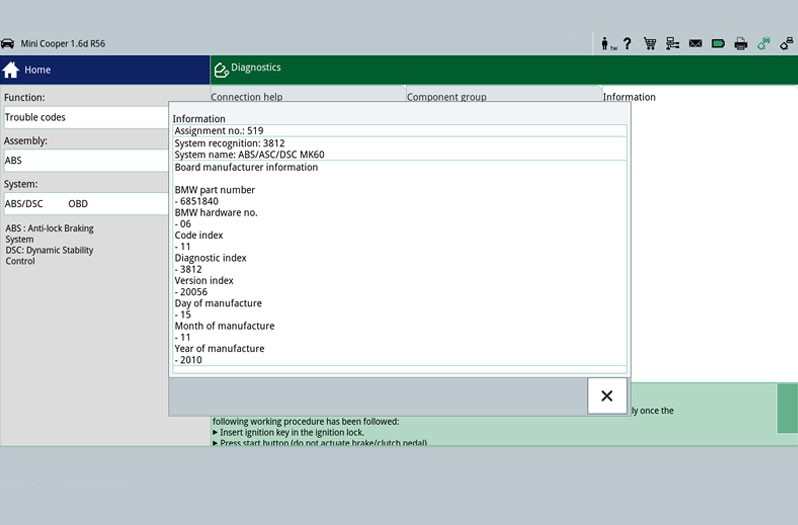
Identification

Special system and control unit information can be called up here.

6

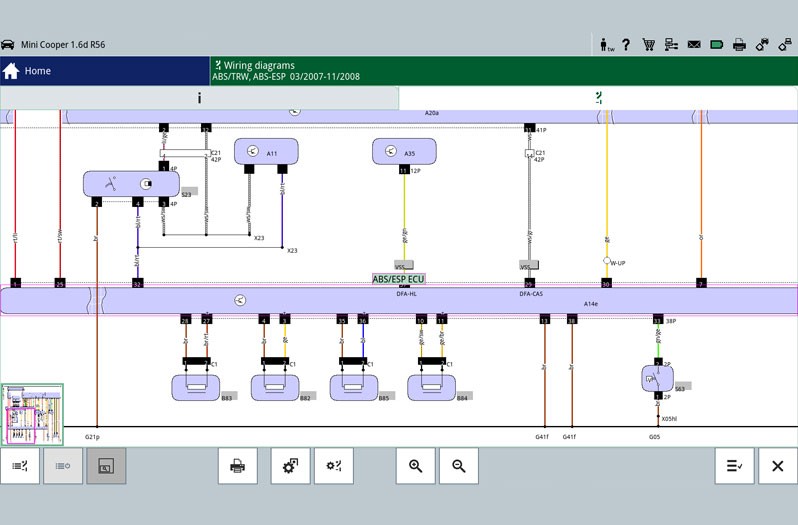
Circuit diagrams

System-specific circuit diagrams can be taken from vehicle information and used for troubleshooting purposes. This is where the PIN assignment on the control unit plug or the cable colours can be read and used for further testing on the electric vacuum pump or on the brake booster pressure sensor.

Important

The various diagnostic possibilities were illustrated using the mega macs 77 diagnostic unit on a MINI ONE 1.6 R56 as an example. The relevant depth of inspection and the variety of functions depend on each individual system configuration of the control unit.

3. Effects

Fault in the electrical system

If a fault is detected in the electrical system, the following measures are initiated:

  • The ABS/ESP system is switched off. The brake system continues to work in the usual way.
  • The fault is shown by the ABS/ESP indicator/control light
4. Important information

Important repair instructions

The following repair instructions are to be strictly observed!

  • Because of its intervention in the brake system, the braking and driving dynamics control unit or the brake system hydraulic unit may only be replaced by trained personnel.
  • After installation of the ABS control unit, it is necessary to adapt it to the vehicle! Please use a suitable diagnostic unit for this purpose.
  • For all repair work on the brake system, please observe the safety and installation instructions provided by the system or vehicle manufacturer in question.
  • If necessary, please use the installation or removal tools specified by the vehicle manufacturer.
  • Repair work that is carried out incorrectly can lead to system failure and to severe personal injuries
  • A
  • B
  • C
  • D
  • E
  • F
  • G
  • H
  • I
  • J
  • K
  • L
  • M
  • N
  • O
  • P
  • Q
  • R
  • S
  • T
  • U
  • V
  • W
  • X
  • Y
  • Z

Anti-lock braking system (ABS)

Prevents the wheels from locking during braking. The steerability and lane stability of the vehicle are maintained.

Electronic stability programme (ESP)

Prevents the vehicle from swerving or skidding by targeted intervention in the brake system and the engine control.

Traction control system (ASR)

Prevents the drive wheels from spinning, on snow or ice, by intervening in the brake system and the engine control.

Até que ponto este artigo é útil para si?

Não ajuda em nada
5
4
3
2
1
Muito útil
Sucesso

Wrong Captcha

Wrong Captcha

Erro

Algo correu mal

Localizador de peças sobressalentes
Identificação manual do veículo OE-no. Peças universais
Principais fabricantes
Outros fabricantes
Série de veículos Voltar
Veículo Voltar

Insira o número OE no campo de entrada. Normalmente, encontrará o número OE na própria peça sobressalente ou nos documentos do veículo.

Localizador de peças sobressalentes
Identificação simples do veículo com matrícula Determine também as peças sobressalentes com números OE Informações detalhadas sobre o produto Encontre grossistas perto de si
dummy
Processing Selected Car
Fabricante
Modelo
Veículo
Potência [CV/kW]
Cilindrada [ccm]
Tipo de combustível
Ano de fabrico
Código do motor

Escolher categoria:
Voltar
dummy
Partilhar
Enviar por Copiar link
URL copiado para o clipboard!
Número do item
Number
O número foi copiado para a sua área de transferência!
Pesquisar na web Instruções de montagem
Mais detalhes
Nome do produto Valor
Menos detalhes

O seu revendedor
Autoteile Krammer GmbH
dummy
Lechstraße 1-3
68199 Mannheim
Mostrar mapa

You might also be interested in

O veículo com sistema ADAS ativo reconhece pedestres e patinetes elétricos no trânsito urbano usando sinais de radar e de sensores - um exemplo de direção autônoma e fusão de sensores.
Conhecimentos básicos
Título ADAS e direção autônoma: Visão geral para as oficinas
Tudo sobre ADAS e direção autônoma: Funções, fusão de sensores, IA e dispositivos de diagnóstico - explicados de forma compacta para profissionais do setor automotivo
Tempo de leitura: 15 minutos
Controlar a sonda lambda
Conhecimentos básicos
Controlar a sonda lambda - Defeito, sintomas, substituição
Descubra como verificar e medir sensores lambda - com instruções passo a passo para o diagnóstico de falhas.
Tempo de leitura: 16 minutos
Conhecimentos básicos
Mobilidade elétrica no dia a dia da oficina: tecnologia e requisitos
A mobilidade elétrica está a mudar os processos nas oficinas: saiba como as oficinas trabalham com sistemas de alta voltagem, novos processos de diagnóstico e qualificação específica
Tempo de leitura: 19 minutos
Sensor do pedal do acelerador
Conhecimentos básicos
Sensor do pedal do acelerador – Funcionamento, estrutura e detecção de erros
Dicas importantes para verificar o sensor do pedal do acelerador e corrigir defeitos – conhecimentos práticos para a sua oficina.
Tempo de leitura: 3 minutos
Avaliação dos danos no alternador
Conhecimentos básicos
Avaliação dos danos no alternador
Motor de arranque com defeito? Descubra causas típicas, como sobrecarga ou falha de ignição, e como reparar os danos de forma eficaz.
Tempo de leitura: 1 minuto
Avaliação de problemas no alternador
Conhecimentos básicos
Avaliação de problemas no alternador
Como diagnosticar danos no alternador: desde corrosão e curtos-circuitos até danos nos rolamentos.
Tempo de leitura: 1 minuto
Bomba de fluido
Conhecimentos básicos
Bomba de fluido - Estrutura, funcionamento e localização de erros
Saiba mais sobre a função e integração do sistema da bomba média, bem como sobre as opções de teste e reparação.
Tempo de leitura: 8 minutos
Polia de roda livre do alternador operação e montagem
Conhecimentos básicos
Explicação do funcionamento e da montagem da polia de roda livre do alternador
Função e design da polia do alternador de ultrapassagem explicados - incluindo instruções de instalação da polia do alternador de ultrapassagem no alternador.
Tempo de leitura: 3 minutos
Verificar o regulador multifuncional
Conhecimentos básicos
Verificar o regulador multifuncional
Descubra como verificar o regulador multifuncional, medir a tensão do gerador e garantir que o regulador está a funcionar corretamente.
Tempo de leitura: 5 minutos
Como testar o alternador
Conhecimentos básicos
Como testar o alternador
Soluções detalhadas para problemas com o alternador - desde testes até à resolução de problemas, tudo para a sua oficina automóvel.
Tempo de leitura: 8 minutos

Pergunta rápida

Ótimo! Só mais um passo

Subscrição bem-sucedida

Aceda à sua caixa de entrada e confirme o seu endereço de e-mail para não perder as nossas atualizações!

Aguarde novos vídeos técnicos, conselhos sobre reparação automóvel, formação, dicas úteis de diagnóstico, campanhas de marketing e muito mais... diretamente na sua caixa de entrada, a cada duas semanas!