Verificar a excentricidade lateral do disco de travão | HELLA
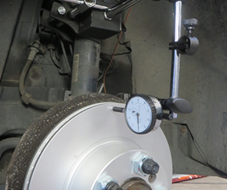
GeralDe modo a prevenir prematuramente vibrações durante a travagem, deve-se controlar a planeza do novo disco de travão com um relógio comparador adequado. A verificação da excentricidade lateral é realizada com o disco de travão montado no veículo. Durante estes trabalhos devem ser considerados os dados técnicos do veículo, do respetivo fabricante automóvel.Valor de referência: desvio máx. da excentricidade lateral de 0,07 mmVerificaçãoRecomenda-se o seguinte procedimento.Montar o disco de travão com todos os parafusos ou porcas das rodas e respetivas anilhas ou distanciadores no cubo da roda.Fixar o suporte do relógio comparador na pata telescópica.Posicionar o relógio comparador cerca de 10-15 mm abaixo do raio externo do disco e ajustar em “zero”.Rodar o disco de travão no sentido de marcha.Ler e apontar os valores de mediçãoOs eventuais desvios devem ser medidos durante várias revoluções do disco e não devem exceder as tolerâncias!Aviso de reparaçãoEsta verificação apenas é fidedigna em discos de travão novos ou seminovos.Em caso de desvios, deve ter-se em consideração o estado do cubo da roda e do rolamento, que poderão ser uma possível fonte de avarias adicional.Observar neste contexto sempre as instruções de manutenção e de reparação dos respetivos fabricantes automóveis.
In order to avoid the problem of brake judder when driving as early as possible, the axial runout of the new brake disc should be tested using a suitable dial gauge. The check of lateral runout is performed with the brake disc installed. The vehicle-specific specifications of the respective vehicle manufacturer are binding.
Guide value: Max. permissible lateral runout 0.07mm
Tests
The following procedure is recommended.
- Install the brake disc on the wheel hub as prescribed with all wheel bolts or wheel nuts, and the corresponding washers and shims.
- Fasten the dial gage with holder to the suspension strut.
- Place the dial gage approx. 10 - 15 mm below the outer radius of the disc and align with 'zero'.
- Turn the brake disc in the direction of travel.
- Read off the measured values and note
Measured over several wheel revolutions, deviations should not exceed the respective tolerance values.
Repair note
- This test should only be carried out on brake discs that are new or like new.
- If deviations are found, the state of the wheel hub and bearing should be considered as further fault sources.
Please always observe the specifications in the maintenance and repair notes provided by the respective vehicle manufacturer.
Mais informações técnicas
Informações técnicas sobre o produto
Bremsbelag-Verschleissanzeige
Tempo de leitura: 1 minuto
Informações técnicas sobre o produto
Aviso de rodagem discos de travão
Tempo de leitura: 4 minutos
Informações técnicas sobre o produto
Strong price increase for refrigerant R134a
Tempo de leitura: 3 minutos
Informações técnicas sobre o produto
Avaliação de danos — Suspensão das rodas e direção
Tempo de leitura: 1 minuto
Informações técnicas sobre o produto
Toyota Auris — Restrições no funcionamento devido ao ajuste do banco
Tempo de leitura: 1 minuto
Informações técnicas sobre o produto
Peças de desgaste do travão de roda — Aviso sobre o armazenamento
Tempo de leitura: 3 minutos
Informações técnicas sobre o produto
Peças sobressalentes para travões com componentes em borracha — Aviso sobre o armazenamento
Tempo de leitura: 3 minutos
Informações técnicas sobre o produto
Amortecedores de vibração na pinça de travão
Tempo de leitura: 2 minutos
Informações técnicas sobre o produto
Verificar a excentricidade lateral do cubo da roda
Tempo de leitura: 2 minutos
Informações técnicas sobre o produto
Aviso de reparação, pinça de travão — Pinça móvel Teves, série FN, desmontar e montar o travão de disco
Tempo de leitura: 16 minutos