Aviso de rodagem dos discos de travão | HELLA
GeralApós a montagem de novos discos de travão e calços, as superfícies de fricção de ambos os componentes necessitam de algum tempo para se adaptarem umas às outras.Para assegurar o funcionamento perfeito e seguro do travão de roda, é necessário adaptar as superfícies de fricção umas às outras através de travagens cuidadosas.Se estes componentes não forem devidamente travados, pode ocorrer uma transferência indesejada de material e depósitos irregulares nas superfícies de fricção. Isto pode levar a vibrações ou ruídos incómodos. Para evitar reclamações desnecessárias, recomendamos as seguintes instruções de rodagem e de montagem.Avisos de rodagemDurante o período de rodagem, observar os seguintes avisos.O processo de rodagem deve apenas ser realizado em estradas onde esta manobra possa ser realizada em segurança.A rodagem deve ser efetuada com um atraso habitual adaptado à circulação na via pública, através de um aquecimento gradual sem choque térmico.As primeiras travagens devem ser efetuadas de forma suave e cuidadosa a partir de um máx. de 50 km/h.Em seguida, efetuar várias travagens a uma velocidade média.Entre os ciclos de travagem, deixar arrefecer o disco de travão através da corrente de ar.Por fim, deixar o sistema de travagem arrefecer com uma condução moderada.Evitar travagens fortes ou prolongadas para alcançar mais rapidamente a adaptação dos dois componentes.Aviso sobre os discos de travão revestidosOs discos de travão revestidos são lacados, em vários processos, com um revestimento que lhes atribui características de resistência às influências climatéricas e térmicas. Uma vez que isto também se aplica ao anel de fricção do disco de travão, deve ser observado o seguinte durante o período de rodagem.Devido à remoção do material de revestimento, podem ocorrer ruídos de moagem ou uma ligeira formação de fumo durante as primeiras travagens, mas tal é inofensivo.Após o período de rodagem, as superfícies de fricção devem estar limpas.O material de revestimento que se solta em frente aos calços de travão não tem qualquer influência no comportamento de travagem posterior.Aviso de reparaçãoNeste contexto, observe sempre também os avisos de manutenção e de reparação do fabricante do veículo!Para garantir a segurança na circulação na via pública através de um funcionamento ideal do sistema de travagem, recomendamos que este seja “rodado” antes de ser entregue ao cliente.Caso não haja possibilidade de rodar o sistema de travagem durante a rotina diária da oficina, informar o cliente na medida do necessário.
After mounting the new brake discs and pads, the friction surfaces of both components need a certain time to adapt to one-another.
In order to guarantee a safe and trouble-free function of the wheel brake, it is necessary to match the friction surfaces to one-another by running-in the brake.
If these components are not braked-in correctly, undesired material transfer and uneven distribution of deposits may occur on the friction surfaces. This may lead to unpleasant vibrations or noises. In order to avoid unnecessary complaints, we recommend the following running-in and assembly notes for this reason.
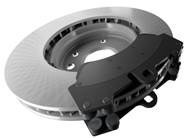
Running-in notes
During the running-in time, observe the following notes in all cases.
- The running-in procedure should only be carried out on road sections that permit these manoeuvres to be carried out in a safe manner.
- The running-in should be carried out with a delay that is adapted for usual road traffic by heating gradually without thermal shock.
- The first braking procedures should be carried out gently and carefully from max. 50 km/h.
- Then carry out several braking actions from medium speed.
- Between the braking cycles, it is essential to allow the brake discs to cool using the airstream.
- Finally, allow the brake system to cool down using a moderate driving style.
- Avoid unnecessary hard or continuous braking to achieve a quicker adoption.
Notes on coated brake discs
Coated brake discs are painted with a weather and temperature resistant top coat in different processes. As these are applied to the friction ring of the brake disc, the following must be observed during the running-in period.
- During the first braking actions, grinding noises or an uncritical slight development of smoke may occur during the removal of the coating material.
- After being run-in, the friction surface must be bare bright metal.
- The coating material removed in front of the brake pad does not have any influence on the further braking behavior.
Repair note
- Please also observe the maintenance and repair notes provided by the respective vehicle manufacturer in this context!
- To ensure that safety is guaranteed in road traffic by the optimum function of the brake system, we recommend that it is "run-in" before being supplied to the customer.
- If it is not possible to run-in the brake system in the day-to-day workshop activities, inform your customer as necessary.
