Checking the air mass sensor: causes, diagnosis and troubleshooting

The air-mass sensor calculates the intake air mass in internal combustion engines. The engine control requires this variable in order to control a wide range of functions. This page explains the design and function of the air-mass sensor. You will also find information about how a faulty air-mass sensor can manifest itself, the causes leading to its failure, and how it can be checked in the workshop.

Important safety note

The following technical information and practical tips have been compiled by HELLA in order to provide professional support to vehicle workshops in their day-to-day work. The information provided on this website is intended for suitably qualified personnel only.

1. Functional principle

Air-mass sensor function

The air-mass sensor is used to measure the intake air mass. It consists of a tubular housing with flow straightener, sensor protection, and sensor module. It is mounted in the intake pipe between the air filter housing and the intake manifold.

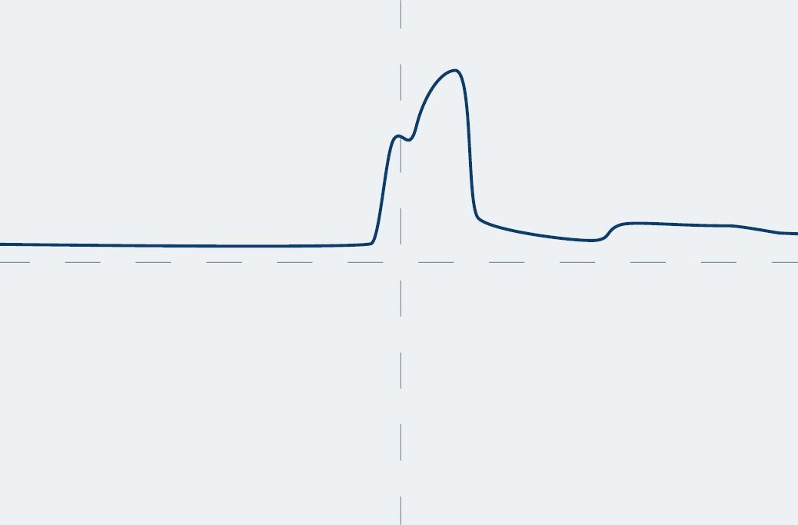
Two temperature-dependent metal film resistors affixed to a glass membrane are arranged in the air flow. The first resistor (RT) is a temperature sensor and measures the air temperature. The second resistor (RS) is used to detect the air flow rate. The resistor RS cools down to a greater or lesser degree depending on the intake air flow. In order to balance out the constant temperature difference between resistors RT and RS, the current flow through resistor RS must be dynamically regulated by the electronics. This heat flow is used as a measured variable for the respective air mass that is taken in by the engine. This measured value is required by the engine management control unit to calculate the fuel quantity required.

2. Symptoms

Faulty air-mass sensor symptoms

A faulty air-mass sensor may manifest itself as follows:

  • The engine stops or the engine management control unit enters an emergency program
  • Engine indicator lamp comes on
3. Cause of failure

Faulty air-mass sensor

Causes for failure of the air-mass sensor can be:

  • Contact fault at the electrical connections
  • Damaged measuring elements
  • Mechanical damage (vibrations, accident)
  • Detachment of measuring elements (leaving the measuring framework)
4. Troubleshooting

Testing the mass air flow sensor

The following test steps should be considered during troubleshooting:

1

Checking the plug connection

Check plug connection for tight fit and correct contact.

2

Checking the air-mass sensor

Check the air-mass sensor for damage.

3

Checking the measuring elements

Check the measuring elements for damage.

4

Checking the voltage supply

Check the voltage supply

5

Checking the connecting cables

Check the connecting cables between the removed control unit plug and the sensor plug for continuity (circuit diagram required for pin assignment). Reference value: approx. 0 ohms.

6

Electronic test of the air-mass sensor

Electronic test of the air-mass sensor through the engine management control unit. When a fault occurs, a fault code is stored in the control unit that can be read out using a diagnostic unit.
5. Video

Replacing a mass air flow sensor

Correct replacement of the air-mass sensor

Replacement of the air-mass sensor including removal and installation.

02:43 min

How helpful is this article for you?

Not helpful at all
5
4
3
2
1
Very helpful
Success

Wrong Captcha

Wrong Captcha

Error

Something went wrong

Spare Parts Finder
OE-No. Manual Vehicle Identification Universal Parts
Top manufacturers
Other manufacturers
Vehicle series Back
Vehicle Back

Enter the OE number in the input field. You will usually find the OE number on the spare part itself or in the vehicle documents.

Spare Parts Finder
Simple vehicle identification Also determine spare parts with OE numbers Detailed product information Find wholesalers near you
dummy
Processing Selected Car
Manufacturer
Vehicle series
Vehicle
Engine output
Engine displacement
Fuel type
Construction year
Engine code

Choose category:
Back
dummy
Teilen Sie
Send via Copy link
URL copied to the clickboard !
Article NUmber
Number
Article Number Was Copied !
Search The Web Mounting Instructions
More Details
Name Value
Less Details

Your Dealer
Autoteile Krammer GmbH
dummy
Lechstraße 1-3
68199 Mannheim
Show Map

You might also be interested in

Basic Knowledge
E-mobility in everyday workshop activities: technology and requirements
Electromobility is changing workshop processes: find out how workshops handle high-voltage systems, new diagnostics procedures and targeted qualifications
Reading Time: 16 minutes
Starter damage assessment
Basic Knowledge
Starter damage assessment
Starter faulty? Spot typical causes such as overloading or misfiring and find out how to repair damage effectively.
Reading Time: 1 minute
Starter damage assessment
Basic Knowledge
Alternator damage assessment
How to diagnose damage to the alternator: ranging from corrosion and short circuits right up to bearing damage.
Reading Time: 1 minute
Intake-air temperature sensor
Basic Knowledge
Intake-air temperature sensor - checking & faults
Discover how to check the intake air temperature sensor for defects and how to replace it efficiently.
Reading Time: 3 minutes
TPS sensor
Basic Knowledge
TPS sensor – function & troubleshooting
Learn how to check a throttle potentiometer for defects and recognize the most common symptoms.
Reading Time: 2 minutes
Coolant temperature sensor
Basic Knowledge
Coolant temperature sensor testing
Instructions for testing the coolant temperature sensor with a multimeter - diagnosis and repair for your workshop.
Reading Time: 3 minutes
What is a lambda sensor?: Comprehensive technical information
Basic Knowledge
Lambda sensor testing and troubleshooting
Find out how to check and measure lambda sensors - with step-by-step instructions for fault diagnosis.
Reading Time: 14 minutes
Idle speed controllers / idle speed actuators
Basic Knowledge
Idle speed controller & actuator - function & check
Everything you need to know about testing and troubleshooting idle speed regulators: function, typical symptoms and repair tips for your workshop.
Reading Time: 3 minutes
Camshaft position sensor
Basic Knowledge
Camshaft position sensor - function & troubleshooting
Learn all about the function and testing of the camshaft sensor and possible symptoms of a defect.
Reading Time: 2 minutes
Car knock sensor
Basic Knowledge
Car knock sensor - function & troubleshooting
Find out how to check the knock sensor for malfunctions and rectify possible fault symptoms.
Reading Time: 2 minutes

Quick question

How likely are you to recommend our company to others?

highly unlikely
very likely
highly unlikely
very likely

Thank you very much!

Your feedback helps us to further develop our services.