Vehicle level sensor – Design, function and troubleshooting
The vehicle level sensor is a central component for monitoring the vehicle height. The sensor measures the vertical position of the vehicle body relative to the axle or chassis. Its measurement data forms the basis for numerous vehicle systems such as the automatic headlamp levelling system, adaptive chassis systems and various stability and comfort functions.
Important safety information
The following technical information and practical tips have been compiled by HELLA in order to provide professional support to vehicle workshops in their day-to-day work. The information provided on this website is intended for use by suitably qualified personnel only.
Design and function principle of the vehicle level sensor
Vehicle level sensors are angular position sensors that are attached directly to chassis and body parts. They consist of a sensor housing that is firmly connected to the body or axle beam via a bracket, and a lever arm that is attached, for example, to the transverse control arm. The lever arm can have different lengths and methods of connection, depending on the vehicle version.
If the position between the moving chassis parts and the vehicle body or axle beam changes, the lever arm moves accordingly. It transmits this movement directly to the sensor, where it is converted into a rotary movement. The sensor converts this rotary movement into an electrical signal and sends it to the higher-level control unit. In this way, changes in ride height can be precisely detected and used to control chassis and comfort systems.
As vehicle level sensors are also used in safety-relevant systems, a particularly high level of reliability is required. That is why redundant sensors are often used. Two independent measuring channels then work in parallel. Both channels detect the same movement and each sends a signal to the higher-level control unit. If the two signal values differ from each other, the control unit detects an irregularity and can react appropriately. In this way, a possible failure is detected in good time and the functional safety of the overall system is ensured.
Sensor types frequently used in practice are:
Areas of application
Vehicle level sensors are used in various vehicle systems:
| Application | Objective | Systems involved |
| Automatic headlamp levelling | Glare-free light pattern | Level sensor + headlight control unit |
| Air suspension | Constant ground clearance | Level sensor + air suspension control unit |
| Dynamic chassis control | Comfort and driving stability | Level sensor + damper control |
| Trailer operation | Stable vehicle level and glare-free light when loaded | Level sensor + automatic headlamp levelling or level control |
Furthermore, angular position sensors can also be used in other areas, for example in agricultural vehicles or construction machinery. They are used there, for example, to detect the flap position on trailers or the bucket position on construction machinery.
Causes of failure and symptoms
Vehicle level sensors are installed in the area of the chassis and are therefore subjected to different loads throughout the vehicle's service life. Typical causes of malfunctions or failure are:
- Mechanical damage: Defective or bent lever arms, for example due to stones, collisions or improper installation.
- Electrical faults: Broken cables, corrosion on plug connections or short circuits due to moisture. Internal malfunctions in the integrated circuit can also lead to faulty signals or a failure.
- Environmental influences: Ingress of water, salt or dirt can damage the seals and the housing.
- Wear on potentiometers: Wear of the resistor track due to continuous operation in older, mechanically operating sensors.
Possible symptoms:
- A warning lamp lights up in the instrument cluster
- Driver information or error messages relating to driver assistance or chassis systems
- Fault in or failure of the automatic headlamp levelling system
- Unusual driving behaviour with adaptive chassis (e.g. too hard or too soft)
- Activation of an emergency running programme in the control unit
Exemplary representation of the control unit diagnostics
The function of the vehicle level sensor is monitored by the higher-level control unit. During diagnostics, not only can the fault memory be read out but also additional functions such as parameter queries or circuit diagrams can be displayed, depending on the vehicle type. Basic settings in relation to the vehicle height may also be available, again depending on the vehicle type and configuration.
Maintenance and repair instructions
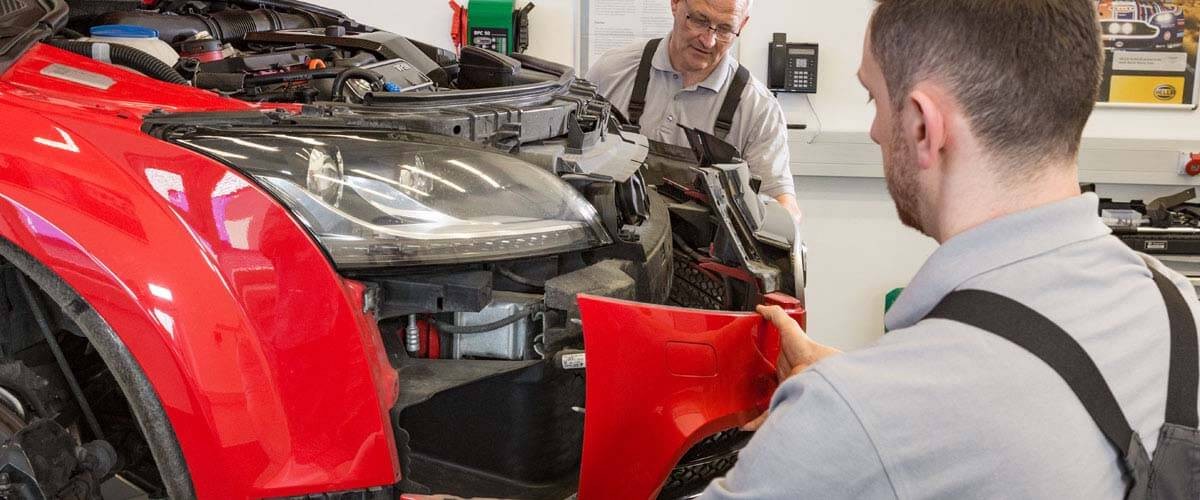
- The vehicle level sensor should only be installed and removed by trained specialists.
- Before installation, ensure that the sensor is suitable for the intended application and that it has the required dimensions, connections and properties.
- After installation, the chassis height should be checked using a suitable diagnostic device. Check that the control position is correctly recognised and that the sensor signals are plausible. Then delete the fault memory.
- Depending on the vehicle type and the work carried out, it may be necessary to recalibrate the control position of the vehicle so that the current ride heights are adopted as reference values. It may also be necessary to calibrate vehicle-specific assistance systems. The ADAS CSC tool from HELLA Gutmann that can be used to precisely calibrate driver assistance systems from different manufacturers is ideal for this work.
- The removal, installation and safety instructions of the respective vehicle manufacturer must be observed in this context.
- HELLA accepts no liability for damage caused by improper handling or incorrect installation.
- Country-specific regulations on occupational safety, accident prevention and disposal must be observed.
Note:
The various diagnostic options have been illustrated as examples using the mega macs X diagnostic unit. The respective test depth and variety of functions can differ from vehicle manufacturer to vehicle manufacturer and depend on the respective system configuration of the control unit. Exemplary representations, pictures and descriptions serve to explain and illustrate the document text and cannot be used as a basis for vehicle-specific repairs.
How helpful is this article for you?
Success
Success
Success
Success
Error
Please tell us what you did not like.
Thank you for your feedback!
Wrong Captcha
Something went wrong
This might also interest you