How workshops can test, replace and adjust NOx sensors at Mercedes-Benz
If a fault is diagnosed with the NOx sensor when troubleshooting an exhaust gas purification system, this can present a challenge for a workshop.
Because of the complexity of the component and the engine management systems, not every NOx sensor can simply be replaced in the plug and play manner so that everything works smoothly afterwards.
Important safety note
The following technical information and practical tips have been compiled by HELLA in order to provide professional support to vehicle workshops in their day-to-day work. The information provided on this website is intended for suitably qualified personnel only.
If a fault is diagnosed with the NOx sensor when troubleshooting an exhaust gas purification system, this can present a challenge for a workshop. Because of the complexity of the component and the engine management systems, not every NOx sensor can simply be replaced in the plug and play manner so that everything works smoothly afterwards. In this article, we would therefore like to take a closer look at some of the special features that need to be taken into account when the NOx sensor has to be replaced. On the one hand, these involve the correct allocation of the spare part and, on the other, the component adjustment after the NOx sensor has been installed. We will illustrate this using a Mercedes Benz E350 (212) BlueTEC produced in 2014 as an example.
Error display
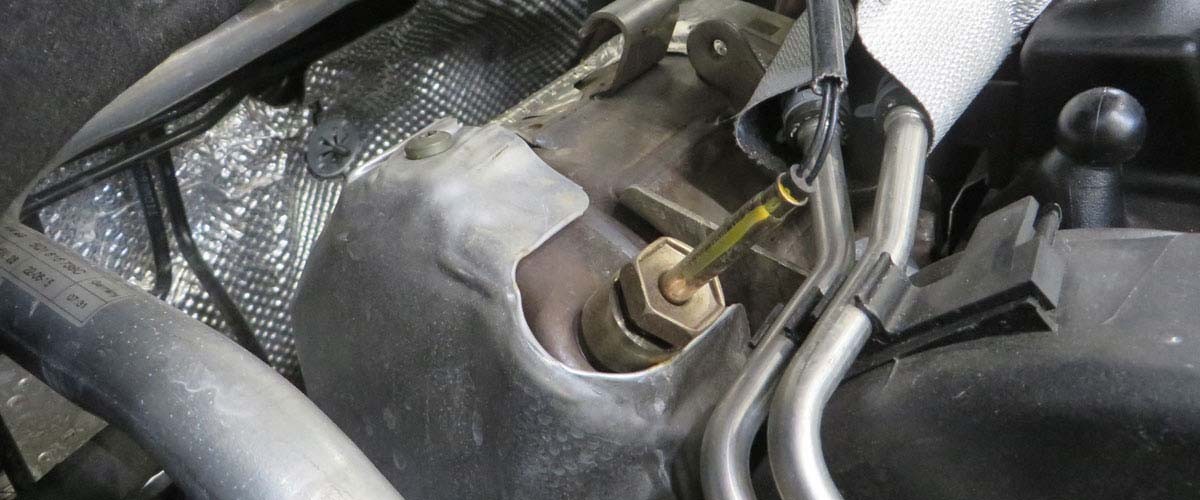
In order to rule out further sources of error, the plug connection on the NOx sensor control unit should be checked for damage or oxidation before replacing the NOx sensor. NOx sensors are usually located on the underbody in the exhaust system and are exposed to environmental influences such as splash water and road salt, substances which can lead to damage. We then recommend checking the power supply and signal line (CAN bus) on the electrical plug connection to the NOx control unit. The best way to check the CAN signal is with an oscilloscope. If all measurement results are satisfactory, then it can be assumed that the NOx sensor is the cause of the error entered. After removing the sensor, the measuring probe should be checked for contamination or damage. Sensors in the exhaust gas system of vehicles with high mileage are often impaired by mechanical engine faults, such as increased oil consumption. If such a defect is diagnosed, it can be assumed that a new NOx sensor will also fail again within a very short time.
Important!
If the AdBlue warning in the instrument cluster is ignored and the driver continues to drive anyway, this can result in the vehicle no longer starting when the remaining distance is exceeded at the next start.
Part identification
Important!
To determine the correct NOx sensor, the data from the vehicle registration document and also the part number of the old sensor should be used as a reference. Finally, a comparison should always be made with the OE part number!
Component customisation
After installation of the NOx sensor with control unit, an adjustment to the vehicle must be made using a suitable diagnostic device. Depending on the vehicle, model and control unit, these adaptations may be designed differently. Sometimes it is sufficient to delete the error code and reset the learned values, but in some cases adjustments can be more elaborate. In our case study, SCN coding must also be carried out in accordance with the vehicle manufacturer's repair guide. (SCN = Software Calibrations Number) This coding is carried out via remote access (remote diagnostics) by connecting the vehicle, diagnostic device and the server of the relevant vehicle manufacturer. This necessary measure allows the control unit software and coding to be recognised and adapted to suit the vehicle in question. This is the only way to ensure secure communication with other control units in the vehicle. If this adjustment is not carried out, communication errors and further error memory entries cannot be ruled out. For this reason, the maintenance and repair instructions of each individual vehicle manufacturer must be strictly observed.
macsRemote Services
Important!
The NOx sensor can be customised using macsRemote Services. Once the vehicle has been identified, the required service can be selected in the application and a ticket created.
Functional check and test drive
Important!
The various diagnostic options have been illustrated using as an example the mega macs X diagnostic device and macsRemote Services. The respective test depth and variety of functions can be set out differently depending on the vehicle manufacturer and these are dependent on the relevant system configuration of the control unit. Schematic illustrations, pictures and descriptions serve to explain the document’s text and cannot be used as a basis for vehicle-specific repairs.
FAQ – Frequently Asked Questions
NOx sensors feature their own control unit with vehicle-specific software. Once installed, the sensor frequently requires calibration to the engine management system, otherwise there will be communication errors within the CAN bus network. Without correct encoding, the SCR control system may malfunction or switch to emergency mode.
Before replacement, check the power supply, ground connection, CAN signals and connectors. An internal sensor or control unit fault is likely if these are nondescript and typical fault codes, such as P229F, or communication faults have been saved. Only then does replacing it make technical sense.
The NOx sensor generates the actual values used to control urea injection. If it fails, the SCR system operates on the basis of the fallback map or it is deactivated altogether. This may cause the emission limit to be exceeded, which triggers the strategy to prevent start-ups.
If there is no NOx feedback or it is implausible, the engine control unit cannot safeguard statutory emissions monitoring. In accordance with OBD and type-approval specifications, a remaining mileage limit activates; the vehicle will not restart on reaching this limit.
NOx sensors vary depending on their installation position, emissions standard and software version. Incorrect article numbers can lead to communication or control errors, even if the mechanical fit is correct. It is therefore essential to check the used part's OE number, particularly in the case of existing replacement chains.
SCN encoding compares the software version, vehicle configuration and control unit network. Only once encoding has been completed will the new NOx sensor be correctly integrated into the complete system. Without this adjustment there may be consequential errors, implausible measured values or further fault entries.
NOx sensors in the exhaust system are constantly exposed to high temperatures, condensation, road salt and splash water. Corroded connectors, damaged cables or internal ageing of the measuring elements are typical causes of failure, particularly in cases where the vehicle has a high mileage.
The sensors in the exhaust stream are contaminated if there is a mechanical engine fault, such as increased oil consumption or incomplete combustion. Unless these causes are eliminated, even a new sensor will soon be damaged or generate implausible readings.
Keep the load conditions consistent during the test drive, with SCR catalytic converter temperatures above 180°C. Only then will it be possible to measure conclusive NOx values upstream and downstream of the catalytic converter. A conversion rate of around 60–90% is considered typical for this system.
Voltage drops during encoding or teach-in value reset may damage control units or interrupt the adaptation process. Consequently, connect a high-performance charger to stabilise the vehicle electrical system during any diagnosis and programming operations.
How helpful is this article for you?
Success
Success
Success
Success
Error
Please tell us what you did not like.
Thank you for your feedback!
Wrong Captcha
Something went wrong
You might also be interested in