Idle speed regulator / idle speed control: Function, fault symptoms and troubleshooting

The idle speed controller ensures that the idle speed of the engine remains constant in all load conditions. On this page you can find out about how the idle speed actuator regulates the intake air mass of the engine, and how the failure of this actuator impacts on the engine running. Practical tips for troubleshooting and assembly instructions help to quickly rectify defects relating to the idle speed controller.

Important safety note

The following technical information and practical tips have been compiled by HELLA in order to provide professional support to vehicle workshops in their day-to-day work. The information provided on this website is intended for suitably qualified personnel only.

1. Functional principle

Idle speed controller function

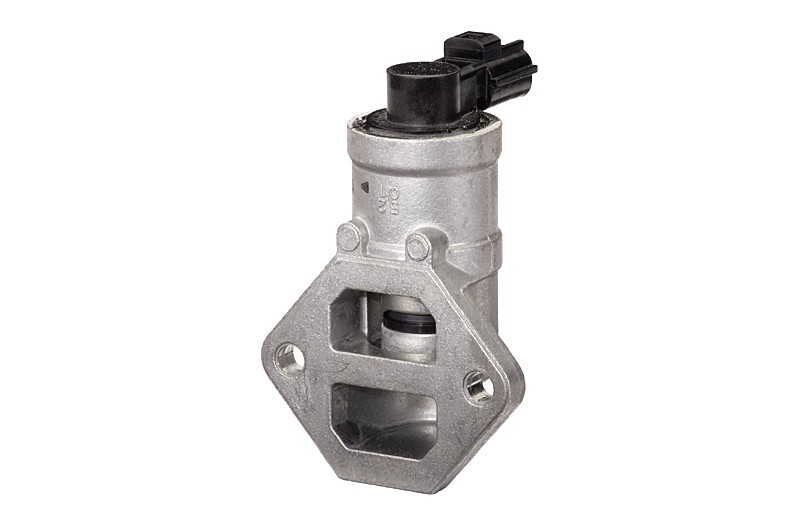
The idle speed actuator is a bypass air valve. The idle speed actuator shown as an example consists of a closed cast housing with flange-mounted solenoid valve servo unit. Attached to this is a nozzle holder, which releases different air cross sections by moving the servo unit, and can therefore control the air mass flow when the throttle valve is closed.

The idle speed actuator is responsible for regulating the engine speed as part of the overall idle-speed control of the engine management system. If there is a sudden change to the engine load condition when in idle mode (e.g. air-conditioning system being switched on, creep speed in 1st gear, or activation of another electrical consumer), air and fuel are also required in order to prevent the engine from stopping. If the engine speed falls below a certain critical value, which is stored as a constant in the control unit memory, the solenoid valve is activated and an increased air flow rate is achieved. The opening time of the injection valves is simultaneously extended and adapted to the engine's requirements.

2. Symptoms

Symptoms of a faulty idle speed controller

A faulty idle speed actuator can manifest itself as follows:

  • Fluctuating idle speed
  • Engine stops running at idle speed
  • Engine stops running at idle speed and activation of additional consumers
  • Engine indicator lamp comes on
3. Cause of failure

Causes for faulty idle speed controllers

Causes for failure of the idle speed actuator can be:

  • Contamination / resin formation
  • Short circuits in the coil
  • Electric magnetic drive becomes stuck
  • No voltage supply from the engine management control unit
4. Troubleshooting

Checking the idle speed actuator

The following test steps should be considered during troubleshooting:

1

Checking the voltage supply

Check the voltage supply with the ignition switched on.

  • Measured value: 11 – 14 V.

Note:
An Ohm measurement must only be carried out in a de-energized state (plug connection removed).

2

Measuring the coil resistance

Use the multimeter to measure the coil resistance between the two connection pins of the idle speed actuator.

  • Reference value = approx. 10 ohms (observe manufacturer's specifications).

3

Checking the coil for winding short circuit

Check the coil for a winding short circuit between the two connection pins.

  • Measured value in the event of a short circuit = 0 ohms.

4

Checking the coil for winding interruption

Check the coil for a winding interruption between the two connection pins.

  • Measured value in the event of an interruption = >30 MOhm.

5

Checking the coil for short circuit to frame

Check the coil for short circuit to frame – between pin 1 and component housing, and between pin 2 and component housing.

  • Measured value in the event of an unimpaired coil = >30 MOhm.

6

Mechanical check

Unscrew the servo unit from the housing. Visual check to determine whether the bypass opens and closes when the valve rod is actuated.

7

Read out fault code

Read out fault code.

ASSEMBLY INSTRUCTIONS

Before mounting the idle speed actuator, the supporting surface must be cleaned and, if necessary, the flange seal must be replaced.

Observe the tightening torque!

  • Fixing screws 12 – 15 Nm

Please observe the specifications provided by the respective vehicle manufacturer.

How helpful is this article for you?

Not helpful at all
5
4
3
2
1
Very helpful
Success

Wrong Captcha

Wrong Captcha

Error

Something went wrong

Spare Parts Finder
Oe-No. Manual vehicle identification Universal Parts
Top manufacturers
Other manufacturers
Vehicle series Back
Vehicle Back

Enter the OE number in the input field. You will usually find the OE number on the spare part itself or in the vehicle documents.

Spare Parts Finder
Simple vehicle identification Also determine spare parts with OE numbers Detailed product information Find wholesalers near you
dummy
Processing Selected Car
Manufacturer
Vehicle series
Vehicle
Engine output
Engine displacement
Fuel type
Construction year
Engine code

Choose category:
Back
dummy
Teilen Sie
Send via Copy link
URL copied to the clickboard !
Article NUmber
Number
Article Number Was Copied !
Search The Web Mounting Instructions
More Details
Name Value
Less Details

Your Dealer
Autoteile Krammer GmbH
dummy
Lechstraße 1-3
68199 Mannheim
Show Map

You might also be interested in:

Replacing the horn
Basic Knowledge
Replacing the horn - Instructions
Step-by-step instructions for replacing the horn on various models such as the Audi TT/RS and Grand Cherokee.
Reading Time: 5 minutes
Check multifunction controller
Basic Knowledge
Checking the alternator regulator
Find out how to check the multifunction regulator, measure the generator voltage and ensure that the regulator is functioning correctly.
Reading Time: 4 minutes
HELLA 77 GHz radar sensors: Design, function and applications
Basic Knowledge
Maintenance and diagnostics of 77 GHz radar sensors
Find out how the HELLA 77 GHz radar sensor supports driver assistance systems and accurately identifies objects in any weather conditions. Discover the design, function and applications in the vehicle.
Reading Time: 7 minutes
A vehicle with an active ADAS system recognises pedestrians and e-scooters in urban traffic by means of radar and sensor signals – a good example of autonomous driving and sensor fusion.
Basic Knowledge
Title ADAS and autonomous driving: an overview for workshops
Everything you need to know about ADAS and autonomous driving: functions, sensor fusion, AI and diagnostic devices – concisely explained for automotive professionals
Reading Time: 14 minutes
Basic Knowledge
E-mobility in everyday workshop activities: technology and requirements
Electromobility is changing workshop processes: find out how workshops handle high-voltage systems, new diagnostics procedures and targeted qualifications
Reading Time: 16 minutes
Starter damage assessment
Basic Knowledge
Alternator damage assessment
How to diagnose damage to the alternator: ranging from corrosion and short circuits right up to bearing damage.
Reading Time: 1 minute
Starter damage assessment
Basic Knowledge
Starter damage assessment
Starter faulty? Spot typical causes such as overloading or misfiring and find out how to repair damage effectively.
Reading Time: 1 minute
Intake-air temperature sensor
Basic Knowledge
Intake-air temperature sensor - checking & faults
Discover how to check the intake air temperature sensor for defects and how to replace it efficiently.
Reading Time: 3 minutes
Coolant temperature sensor
Basic Knowledge
Coolant temperature sensor testing
Instructions for testing the coolant temperature sensor with a multimeter - diagnosis and repair for your workshop.
Reading Time: 3 minutes
Air-mass sensor
Basic Knowledge
Air-mass sensor - Function & troubleshooting
Learn how to check a mass air flow sensor, detect defective sensors and replace them professionally.
Reading Time: 2 minutes

Quick question

Great! Just one more Step

Subscription successful

Head to your inbox and confirm your email address so that you don’t miss our updates!

Get ready for brand new technical videos, car repair advice, trainings, helpful diagnostic tips, marketing campaigns and much more... delivered straight to your inbox every two weeks!