Crankshaft sensor

The crankshaft sensor is one of the key providers of information of the engine control. It detects the speed and position of the crankshaft and forwards this information to the engine control in the form of an electrical signal. On this page, you can find out how crankshaft sensors work, and what must be taken into account when checking them in order to prevent damage.

Important safety note

The following technical information and practical tips have been compiled by HELLA in order to provide professional support to vehicle workshops in their day-to-day work. The information provided on this website is intended for suitably qualified personnel only.

1. Functional principle

Crankshaft position sensor function

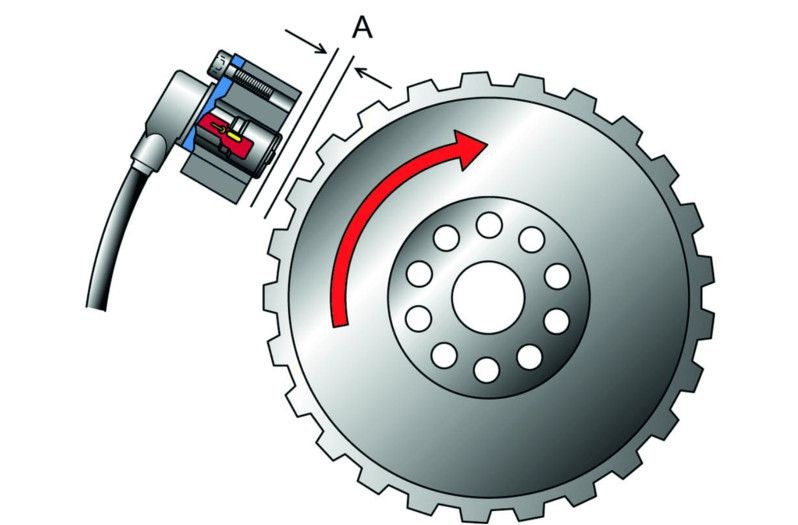
The function of crankshaft sensors is to measure the crankshaft's speed and position. They are most commonly installed near to the flywheel ring gear. There are two designs: Inductive sensors and Hall generators. Before the crankshaft sensor is tested, it is essential to know which type of transmitter is involved.

The rotary movement of the ring gear results in changes to the magnetic field. These generate varying voltage signals in the crankshaft sensor, which are transmitted to the control unit. The control unit uses the signals to calculate speed and position of the crankshaft in order to gain important basic data for injection and ignition timing.

2. Symptoms

Crankshaft sensor defective

A faulty crankshaft sensor can cause the following symptoms:

  • Engine stalls
  • Engine standstill
  • Problems starting
  • Error code is stored
3. Cause of failure

Causes of defective crankshaft sensors

Causes of failure can be:

  • Internal short circuits
  • Breaks in wiring
  • Wiring short circuit
  • Mechanical damage to the encoder wheel
  • Soiling caused by metal abrasion
4. Troubleshooting

Checking the crankshaft sensor

Troubleshooting:

The following procedure is recommended for troubleshooting:

    1. Read out the fault memory
    1. Check the electrical connections of the sensor wiring, the connector, and the sensor for correct connection, breaks, and corrosion.
    1. Watch out for soiling and damage

Direct checks on the crankshaft sensor can be difficult if the exact design type of the sensor is not known. Before the checks, it must be clear whether the sensor is an inductive sensor or Hall generator. It is not always possible to distinguish between the two in terms of appearance. If there are three pins on the connector, no precise statements can be made about the respective type. The specific manufacturer specifications and the specifications in the spare-parts catalog provide further assistance here.

If the design type has not been definitively clarified, an ohmmeter must not be used for the tests. The voltage from the measuring device used for the resistance test could destroy a Hall generator!
If the sensor has a 2-pin connector, it is most likely an inductive sensor. In this case it is possible to determine the internal resistance, a potential short circuit to frame, and the signal. To do this, remove the plug connection and check the internal resistance of the sensor. If the internal resistance value is 200 to 1,000 ohms (depending on the reference value), the sensor is OK. If the value is 0 ohms, there is a short circuit, and in the case of M Ohm there is an interruption. The test for a short circuit to frame is carried out using the ohmmeter from a connection pin to vehicle ground. The resistance value must tend toward infinity. The test using an oscilloscope must result in a sinus signal of sufficient strength. In the case of a Hall generator, only the signal voltage in the form of a square wave signal and the supply voltage are to be tested. This must result in a square wave signal depending on the engine speed.

We should warn again at this point that the use of an ohmmeter can destroy the Hall generator.

Assembly instructions

Make sure that the distance to the encoder is correct and that the sensor is fitted correctly.

How helpful is this article for you?

Not helpful at all
5
4
3
2
1
Very helpful
Success

Wrong Captcha

Wrong Captcha

Error

Something went wrong

Spare Parts Finder
Oe-No. Manual vehicle identification Universal Parts
Top manufacturers
Other manufacturers
Vehicle series Back
Vehicle Back

Enter the OE number in the input field. You will usually find the OE number on the spare part itself or in the vehicle documents.

Spare Parts Finder
Simple vehicle identification Also determine spare parts with OE numbers Detailed product information Find wholesalers near you
dummy
Processing Selected Car
Manufacturer
Vehicle series
Vehicle
Engine output
Engine displacement
Fuel type
Construction year
Engine code

Choose category:
Back
dummy
Teilen Sie
Send via Copy link
URL copied to the clickboard !
Article NUmber
Number
Article Number Was Copied !
Search The Web Mounting Instructions
More Details
Name Value
Less Details

Your Dealer
Autoteile Krammer GmbH
dummy
Lechstraße 1-3
68199 Mannheim
Show Map

You might also be interested in

Basic Knowledge
E-mobility in everyday workshop activities: technology and requirements
Electromobility is changing workshop processes: find out how workshops handle high-voltage systems, new diagnostics procedures and targeted qualifications
Reading Time: 16 minutes
Starter damage assessment
Basic Knowledge
Alternator damage assessment
How to diagnose damage to the alternator: ranging from corrosion and short circuits right up to bearing damage.
Reading Time: 1 minute
Starter damage assessment
Basic Knowledge
Starter damage assessment
Starter faulty? Spot typical causes such as overloading or misfiring and find out how to repair damage effectively.
Reading Time: 1 minute
Intake-air temperature sensor
Basic Knowledge
Intake-air temperature sensor - checking & faults
Discover how to check the intake air temperature sensor for defects and how to replace it efficiently.
Reading Time: 3 minutes
Coolant temperature sensor
Basic Knowledge
Coolant temperature sensor testing
Instructions for testing the coolant temperature sensor with a multimeter - diagnosis and repair for your workshop.
Reading Time: 3 minutes
Air-mass sensor
Basic Knowledge
Air-mass sensor - Function & troubleshooting
Learn how to check a mass air flow sensor, detect defective sensors and replace them professionally.
Reading Time: 2 minutes
Idle speed controllers / idle speed actuators
Basic Knowledge
Idle speed controller & actuator - function & check
Everything you need to know about testing and troubleshooting idle speed regulators: function, typical symptoms and repair tips for your workshop.
Reading Time: 3 minutes
Car knock sensor
Basic Knowledge
Car knock sensor - function & troubleshooting
Find out how to check the knock sensor for malfunctions and rectify possible fault symptoms.
Reading Time: 2 minutes
Accelerator pedal sensor
Basic Knowledge
Accelerator pedal sensor – function & design
Important tips for checking the accelerator pedal sensor and rectifying defects - practical knowledge for your workshop.
Reading Time: 3 minutes
Injection nozzle/injection valve
Basic Knowledge
Injection nozzle/injection valve – Function & checks
Find out how to diagnose a defective fuel injector and replace it in the workshop.
Reading Time: 6 minutes

Quick question

How likely are you to recommend our company to others?

highly unlikely
very likely
highly unlikely
very likely

Thank you very much!

Your feedback helps us to further develop our services.