Function and assembly of the alternator freewheel clutch

Important safety note

The following technical information and practical tips have been compiled by HELLA in order to provide professional support to vehicle workshops in their work. The information provided on this website is intended for use by suitably qualified personnel only.

1. Basics

Overrunning belt pulleys on alternators

During an engine's combustion cycle, the rotary movement of the crankshaft is sped up and slowed down This rotational irregularity is transferred to the accessory drive as a result of the alternator's moment of inertia As a result, extreme forces and high torque fluctuations act on the belt drive

2. Function

Function and structure of the alternator freewheel clutch

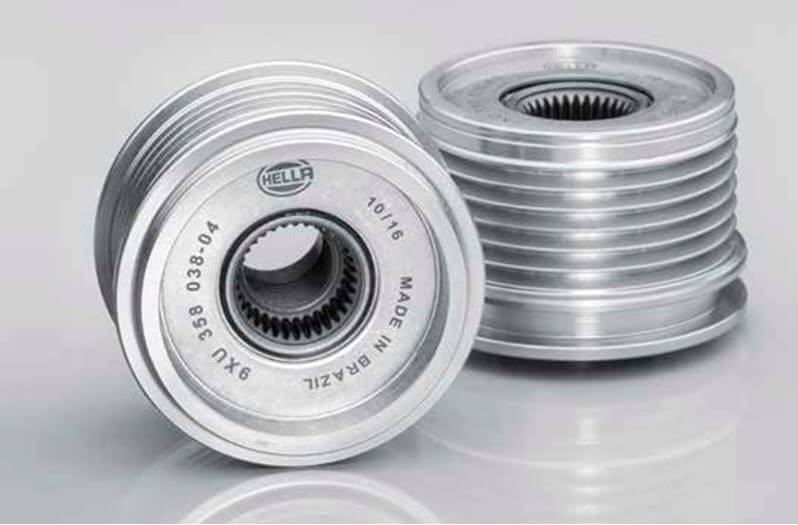
The overrunning alternator pulley, or alternator freewheel clutch, is mounted directly on the drive shaft of the alternator instead of the rigid pulley and has the task of decoupling the three-phase alternator from the rotational irregularities of the crankshaft. This reduces the influence of the moment of inertia on the alternator and the load on the belt drive.

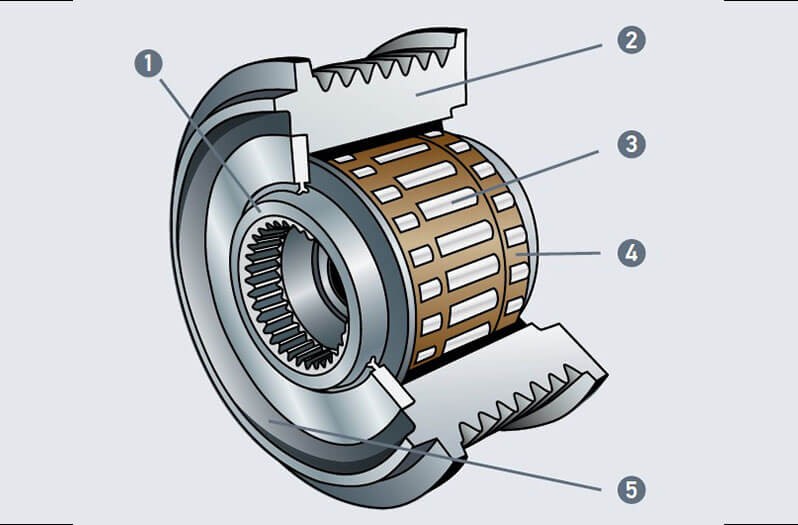
The overrunning alternator pulley is structured as follows:

    1.Inner race with serration
    2.Outer race with profiled raceway
    3.Freewheel unit
    4.Radial support bearings
    5.Overrunning alternator pulley
3. Benefits

Advantages of the alternator freewheel clutch

By mounting an overrunning alternator pulley, only the driving force of one direction of rotation is transmitted to the alternator, thus reducing friction and wear.

Advantages of an overrunning alternator pulley:

  • Reduced impact on the belt drive
  • Reduced fuel consumption
  • Longer lifetime for all components
  • Greater driving comfort and improved noise levels
  • Higher alternator idle speed

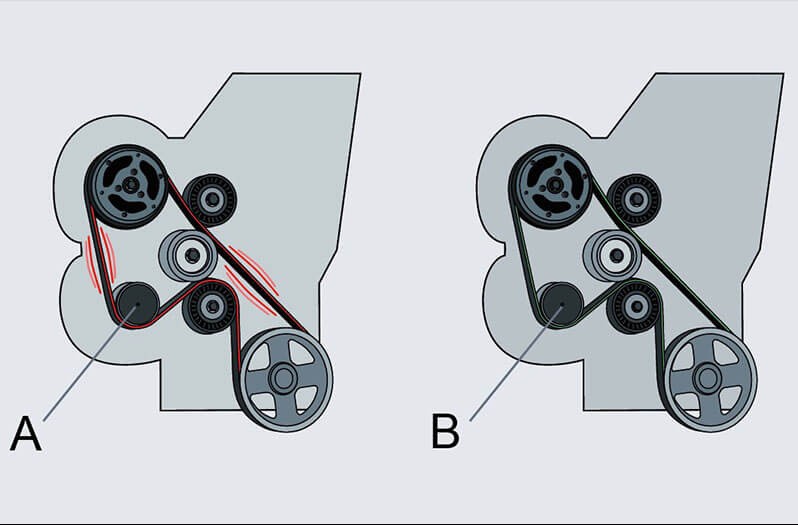
Effects with and without overrunning alternator pulley:

  • Accessory drive with rigid pulley (A): Severe vibrations and resultant thrashing noise from the drive belt
  • Accessory drive with alternator freewheel clutch (B): Reduction in belt vibrations
4. Mounting instructions

Installation instructions for alternator freewheel clutch

Article numbers: 9XU 358 038-xxx and 9XU 358 039-xxx

We recommend the following procedure:

  • Switch off engine
  • Remove ignition key
  • Remove the V-ribbed belts
  • Remove the cover cap on the alternator freewheel clutch
  • Fix the overrunning alternator pulley in place
  • Insert installation tool
  • Rotate installation tool
  • Loosen and remove the alternator freewheel clutch
  • Mount and tighten the new alternator freewheel clutch (tightening torque 80 +/- 5 Nm)
  • Fit cover cap and V-ribbed belts
  • Perform functional check

Important!

Refer to the removal and installation instructions from the relevant
vehicle manufacturer.
  • Installation may only be carried out by a qualified specialist
  • Note tightening torque
  • Do not use pneumatic tools

How helpful is this article for you?

Not helpful at all
5
4
3
2
1
Very helpful
Success

Wrong Captcha

Wrong Captcha

Error

Something went wrong

Spare Parts Finder
Manual vehicle identification Oe-No. Universal Parts
Top manufacturers
Other manufacturers
Vehicle series Back
Vehicle Back

Enter the OE number in the input field. You will usually find the OE number on the spare part itself or in the vehicle documents.

Spare Parts Finder
Simple vehicle identification Also determine spare parts with OE numbers Detailed product information Find wholesalers near you
dummy
Processing Selected Car
Manufacturer
Vehicle series
Vehicle
Engine output
Engine displacement
Fuel type
Construction year
Engine code

Choose category:
Back
dummy
Teilen Sie
Send via Copy link
URL copied to the clickboard !
Article NUmber
Number
Article Number Was Copied !
Search The Web Mounting Instructions
More Details
Name Value
Less Details

Your Dealer
Autoteile Krammer GmbH
dummy
Lechstraße 1-3
68199 Mannheim
Show Map

You might also be interested in

Basic Knowledge
E-mobility in everyday workshop activities: technology and requirements
Electromobility is changing workshop processes: find out how workshops handle high-voltage systems, new diagnostics procedures and targeted qualifications
Reading Time: 16 minutes
TPS sensor
Basic Knowledge
TPS sensor – function & troubleshooting
Learn how to check a throttle potentiometer for defects and recognize the most common symptoms.
Reading Time: 2 minutes
Intake-air temperature sensor
Basic Knowledge
Intake-air temperature sensor - checking & faults
Discover how to check the intake air temperature sensor for defects and how to replace it efficiently.
Reading Time: 3 minutes
Ignition coil
Basic Knowledge
Ignition coil – checking, measuring, faults
Recognize symptoms of a defective ignition coil and get to know ignition coil types - with instructions for troubleshooting and testing.
Reading Time: 14 minutes
Ultrasound-based parking aid - park distance control (PDC)
Basic Knowledge
Park Distance Control (PDC): a parking aid based on ultrasound
Learn all about the function and maintenance of ultrasonic parking aids (PDC), including repair tips.
Reading Time: 5 minutes
Service work on the loading system
Basic Knowledge
Service work on the charging system
Step-by-step instructions for servicing the charging system, including visual inspection and signal testing on the controller.
Reading Time: 6 minutes
Damage assessment starter motor
Basic Knowledge
Alternator damage assessment
How to diagnose damage to the alternator: from corrosion and short circuits to bearing damage.
Reading Time: 1 minute
Damage assessment starter motor
Basic Knowledge
Starter damage assessment
Faulty starter motor? Discover typical causes such as overloading or misfiring and how to repair damage effectively.
Reading Time: 1 minute
Check multifunction controller
Basic Knowledge
Check multi-function regulator
Find out how to check the multifunction regulator, measure the generator voltage and ensure that the regulator is functioning correctly.
Reading Time: 4 minutes
Lane change assistant
Basic Knowledge
Lane change assist
Learn all about the lane change assistant - diagnostic and repair instructions, supplemented by a clear video.
Reading Time: 13 minutes

Great! Just one more Step

Subscription successful

Head to your inbox and confirm your email address so that you don’t miss our updates!

Get ready for brand new technical videos, car repair advice, trainings, helpful diagnostic tips, marketing campaigns and much more... delivered straight to your inbox every two weeks!