Skivebremseklodser | HELLA
GenereltEt vigtigt konstruktionselement i bremsesystemet er bremseklodserne. Bremseskiven udgør sammen med bremseklodserne et slidstærkt friktionspar, der skal kunne modstå ekstreme belastninger.For at opnå de bedst mulige resultater i alle bremsesituationer skal materialesammensætningen i bremseklodserne være afstemt til bremsesystemet.Opbygning af bremseklodserneBremseklodser er opbygget lagvist (se illustrationen).1. Grundplade2. Lim3. Mellemlag4. Friktionsmateriale5. Pulverbelægning6. Sekundære elementerBasis for bremseklodsen er en pulverbelagt grundplade af stål. Bagpladen er individuelt tilpasset til kravene i det pågældende bremsesystem med hensyn til kvalitet, styrke og tolerancer.Den har til opgave at bortlede varmen og styre bremseklodsen i kaliperen. Pulverbelægningen giver bagpladen en effektiv korrosionsbeskyttelse. På denne grundplades påføres limen. Specielt udviklede lime forbinder belægningsmaterialet permanent med bagpladen og garanterer desuden stor modstand mod afrivning. Derefter følger et mellem, også kaldet underlayer Det forbedrer bremseklodsernes hårdhed, modstand mod revner og komfortegenskaber.Til slut pålægges det egentlige friktionsmateriale. Friktionsmaterialet skal opfylde store krav, og det afstemmes derfor præcist til det pågældende anvendelsesområde. De enkelte producenter benytter specielle opskrifter, som forståeligt nok holdes hemmelige. Desuden kan der benyttes sekundære elementer til bremseklodserne.Disse elementer og anordninger medfører en yderligere forbedring af bremsevirkningen og kørekomforten. Det omfatter f,eks, affasning af friktionsmaterialet og dæmpningsplader på grundpladen.Krav til bremseklodserKravene til bremseklodser i biler kan opdeles i kategorierne sikkerhed, komfort og økonomi.1. SikkerhedLang levetid i kraft af mekanisk styrke og høj temperaturbestandighed (op til 800°C).Stabil friktionskoefficient under alle forekommende bremseforhold.Ufølsomhed over for omgivende forhold som vand og snavs.Gode tilkørselsegenskaber.2. KomfortIngen støj og vibrationerLavt pedaltrykIngen miljøbelastning som følge af slidpartikler3. Økonomi- Lav slitage af friktionsbelægning og bremseskive- Lav vægt- Fordelagtige produktionsomkostningerEt yderligere og ikke uvæsentligt krav er naturligvis kvaliteten af bremseklodserne. På grund af det store antal producenter har EU fastsat følgende krav.I EU må der kun monteres bremseklodser, der overholde regulativet ECE-R90 i biler, som er godkendt til dem.Bremseklodserne er mærket hertil på bagsiden.Indgående råstoffer i friktionsmaterialetPå bilområdet skelner man mellem semi-metal-belægninger (metal >50%) og fiberbaserede belægninger (metal Der kan indgå flere hundrede råstoffer i produktionen af friktionsmaterialet.Disse råstoffer inddeles i følgende grupper:MetalFibre og fyldstofferFaste smøremidlerBindemidlerFriktionsfremmere og omformerstofferI gennemsnit indeholder aktuelle opskrifter 25 forskellige råstoffer.Brugen af asbest i friktionsbelægningen har været forbudt i EU siden asbest-forordningen blev indført.
An important structural component of any brake system is the brake pad with its brake lining (the brake pad is made up of the brake lining, the friction element, and various other components including the backing). Together with the brake disc, the brake pad, also called the grinding pad, forms a friction pairing, which is subject to wear and tear. Consequently this has to be able to stand up to extreme pressure and strain.
In order to achieve the best possible results in any and every braking situation, the composition of materials making up the brake pads has to be tailored to suit each individual brake system.
Structure of the Disc Brake Pad
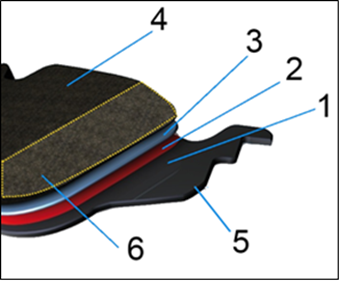
The brake pad has a layered, sandwich-like structure (see diagram).
1. Base plate
2. Glue
3. Intermediate layer
4. Friction material
5. Powder coating
6. Backup safety measure
The fundamental element of the brake pad is a powder-coated base plate made of steel. This is geared to suit the individual requirements of every braking system and corresponds to each one exactly as regards quality, strength and tolerance.
Its task is to dissipate temperature and to guide the pad in the brake calliper. The powder coating enables the base plate to be given reliable protection against corrosion. A layer of adhesive is spread onto this base plate. Specially developed glues ensure that the lining mass is permanently connected to the base plate and, moreover, they guarantee a high degree of shear strength. On top of this is found an intermediate layer, also called the underlayer. This improves the hardness of the actual brake lining, it minimises the risk of its cracking and it adds to the comfort features of the brake system in general.
The last constituent part to be added is the actual friction material itself. This material has a very demanding job to do and for that reason is precisely tailored to meet the needs of each field of application where the braking system is implemented. Every manufacturer uses his own special formula for this, a process or technique which understandably remains a secret. Furthermore, backup safety measures can be added to the brake lining.
Such measures and features bring about even more improvement to the braking effect and to the overall driving comfort during braking. Examples of these features include tapered friction material or damping sheets affixed to the base plate.
The Requirements of Brake Pads and Their Linings
Functional requirements demanded of a brake lining operating in a vehicle can be divided into the categories of safety, comfort and cost effectiveness.
1. Safety
- Long service life as a result of mechanical strength and high temperature resistance (up to 800°C)
- Stability of the friction coefficient in all possible braking situations and under all conditions
- Not sensitive to any environmental influences such as water and dirt
- Good running-in properties
2. Comfort
- No noise or vibrations
- Only slight amount of force needed to operate pedal
- No environmental pollution caused by abrasion
3. Cost-Effectiveness
- Slight wear and tear of the friction lining and of the brake disc
- Lightweight
- Low production costs
Another not unimportant requirement is, of course, the quality of a brake pad and its lining. Because of the huge numbers of manufacturers involved in this product, the European Union (EU) has laid down the following legislation.
Within the EU only brake pads and linings in line with the ECE R90 regulation are permitted to be fitted in a vehicle approved for such equipment.
Relevant labelling identifying this approval can be found on the back plate of the brake pad.
The Raw Material Composition of Friction Material
In the automotive field it is possible to differentiate between semi-metallic linings (Metal >50%) and replaceable fibre linings (Metal < 25%).
Several hundred different raw materials can be used in the making of friction material.
These raw materials can be divided into the following categories:
- Metal
- Fibres and filler materials
- Solid lubricants
- Bonding agents
- Reinforcers of friction coefficient and converting materials
On average current formulas contain 25 different raw materials.
The use of asbestos in friction linings has been prohibited in the EU since the introduction of the Asbestos Directive.