${productDescription}
|
|
|
|
|
|
|
|
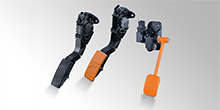
Accelerator pedals designed for upright mounting can be used in a wide variety of vehicles – ranging from automotive sector applications, such as sports cars and electric vehicles, to robust applications in agricultural and construction vehicles.
The measuring principle of the accelerator pedal sensor operates without magnets and is therefore rare-earth-free. It is powered by FORVIA HELLA’s high-precision CIPOS inductive sensor technology - proven over decades in more than one billion applications worldwide! The signal output can be provided in classic analog or digital form.
The housing and pedal plate are made entirely from glass fibre-reinforced plastic. Force transmission and safe resetting are provided by two independent springs. The CIPOS sensor provides the electrical output signal. For this purpose, a sheet metal cursor is routed from the pedal plate with a guide rod via sensor conductor paths on the measuring board. On the measuring board, two galvanically isolated sensors each generate an output signal. The signal type depends on the measuring board. Individual characteristic curves can also be programmed to meet customer-specific requirements.
Accelerator pedals designed for upright mounting can be used in a wide variety of vehicles – ranging from automotive sector applications, such as sports cars and electric vehicles, to robust applications in agricultural and construction vehicles.
The measuring principle of the accelerator pedal sensor operates without magnets and is therefore rare-earth-free. It is powered by FORVIA HELLA’s high-precision CIPOS inductive sensor technology - proven over decades in more than one billion applications worldwide! The signal output can be provided in classic analog or digital form.
The housing and pedal plate are made entirely from glass fibre-reinforced plastic. Force transmission and safe resetting are provided by two independent springs. The CIPOS sensor provides the electrical output signal. For this purpose, a sheet metal cursor is routed from the pedal plate with a guide rod via sensor conductor paths on the measuring board. On the measuring board, two galvanically isolated sensors each generate an output signal. The signal type depends on the measuring board. Individual characteristic curves can also be programmed to meet customer-specific requirements.
Pedal sensor for upright mounting.
Technical drawing of the pedal sensor for upright mounting.
Side view of the pedal sensor for upright mounting.
| Operating voltage | 5 V ± 6% |
| Initial force | 15.5 N |
| Final force | 31 N |
| Actuation angle | 15° |
| Output signal | 2 x analog ratiometric, 2nd channel half pitch |
| Idling voltage | 16% / 8% |
| Full throttle voltage | 79% / 39% |
| Operating temperature | -40 °C to +85 °C |
| Protection class | IP 5K4 |
| Variant | Part number | PU |
|---|---|---|
| Upright pedal sensor | 6PV 312 093-017 | 16 |


|
|
|
|
|
|
|
|