
${productDescription}
|
|
|
|
|
|
|
|

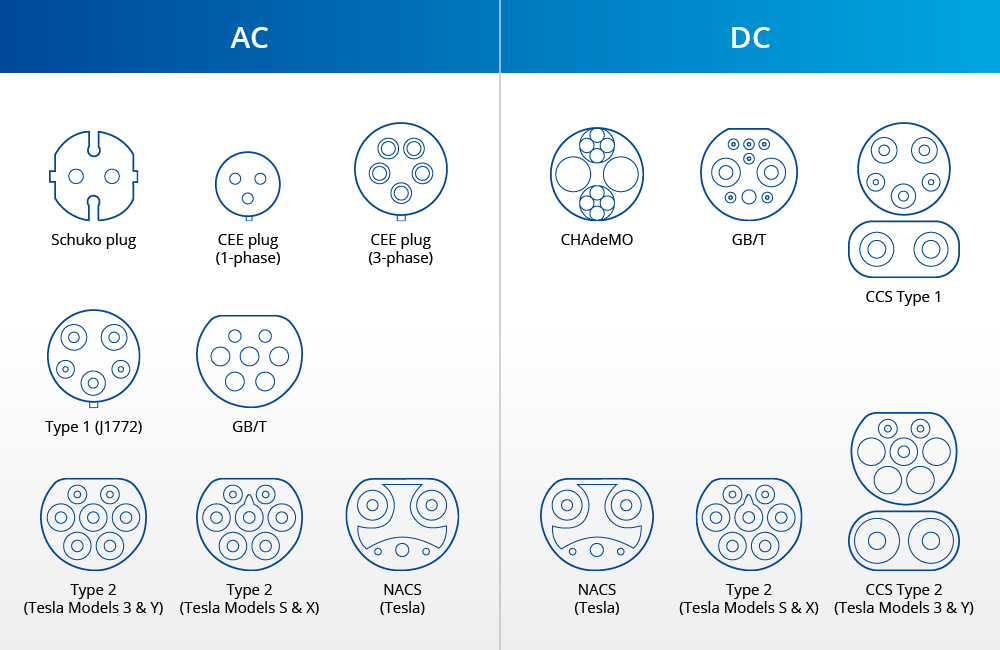
More and more electric vehicles are taking to the roads – you need the right cable with the appropriate charging plug to charge at the wallbox at home or on the go at charging stations. HELLA introduces the different types.
Different charging plug types are used for electric vehicles depending on the region or vehicle manufacturer. To date, there is still no internationally valid standard for electric vehicles' plug types. Within Germany and Europe, however, Type 2 and CCS (Combo) plugs have established themselves as the standard. In addition, there are now many charging stations that offer multiple plug options. Most electric cars now also provide the option of handling different types of charging plugs – either using plugs installed as standard or adapters.
Electric vehicles run on direct current, but the different types of plugs use either alternating current (AC) or direct current (DC). The Type 2 plug, widely used in Europe, uses alternating current, for example, and an integrated rectifier then converts the charged alternating current to direct current.
Type 1 (SAE J1772): This type of plug was developed in the USA and is also widespread in Asia. Vehicle manufacturers, such as Hyundai, Nissan and Ford sell vehicles with this connection. It is made up of a rectangular, single-phase plug with five pins and is used for AC charging. Type 1 plugs normally offer a charging output of up to 7.4 kW. In Germany, this has proven to be more of a disadvantage, as the three-phase electricity grid allows for higher charging output of 11 kW to 43 kW.
Type 2 (IEC 62196-2, Mennekes): Type 2 is one of the most common plug types in Europe and it is also used for AC charging. This type is also known as the Mennekes plug – German company Mennekes Elektrotechnik was involved in its development. The European Commission established the plug type as a standard throughout the EU in January 2013 with the designation EN 62196 Type 2. The plug with seven or nine pins enables a higher charging capacity than Type 1 plugs. Mennekes plugs can support a charging output of up to 22 kW or even 43 kW. Many major vehicle manufacturers, such as Mercedes-Benz, VW and Audi produce Type 2 electric vehicles featuring Type 2 charging cables. The current flows through the three-phase plugs significantly faster than through single-phase Type 1 charging cables.
CCS (Combined Charging System): The Combined Charging System, also known as "Combo 2", is a universal plug type that enables both AC and DC charging. It is based on the Type 2 plug and features additional pins for fast DC charging. CCS plugs are widely used in Europe and support a charging output of up to 350 kW.
CHAdeMO: CHAdeMO is a Japanese plug type used mainly in Japan and some other Asian countries. It also enables fast DC charging and can support a charging output of up to 200 kW. CHAdeMO plugs are also used in some European countries and in North America, but are less common than CCS plugs.
Tesla Supercharger: Tesla, as one of the best-known electric vehicle manufacturers, has its own proprietary, specially developed type of plug. Tesla Superchargers use a modified version of the Type 2 plug and enable fast DC charging. They are mainly used in North America, Europe and Asia.
Schuko plug: In exceptional circumstances, an electric vehicle can also be charged using a normal plug socket, i.e. a Schuko plug. Schuko is an abbreviation for the German term meaning protective contact and fits into household sockets (type CEE 7/3) widespread throughout Europe. However, be careful because these sockets are not designed for a high, continuous load – overheating and cable fires may result. Should the case nevertheless arise, use an emergency cable for charging.
CEE plug or camping plug: the CEE plug is a blue, single-phase type that can also be used as a charging plug for electric vehicles. It is also referred to as the camping plug, because even before the advent of electric vehicles, it had already been used to supply power to mobile homes on campsites. Unlike the conventional Schuko plug, it can be permanently loaded with 3.7 kW. Charging is less time-consuming with the five-pin, red CEE plug (three-phase) for industrial sockets. The small industrial plug (CEE16) is suitable for a charging output of up to 11 kW (400 V, 16 A connected load), the large version (CEE32) delivers up to 22 kW (400 V, 32 A connected load).
There are both charging cables that are permanently connected to a charging station and those that are carried in the vehicle. Two types of cable are particularly common:
As a rule, alternating current (AC) charging stations feature a Type 2 box. Mode 3 cables can therefore be connected to Type 2 plugs with a Type 2 connection and they can handle a charging power of 22 kW. From 43 kW and for fast chargers delivering direct current (DC), charging cables are permanently installed at the charging station. By the way, there are adapters for Type 1 plugs so that they can be connected to a Type 2 socket.
Direct current is delivered using CCS and CHAdeMO charging plugs. The corresponding cables are always permanently attached to the stations.
HELLA offers locking actuators to prevent cable or plug from being prematurely disconnected and ensure that the charging process is secure and cannot be interrupted. These actuators are installed both in the vehicle and at the charging station or wallbox and are suitable for all charging plug types!


|
|
|
|
|
|
|
|