Checking the starter

Since an internal combustion engine cannot start by itself, a functioning starter is essential for a roadworthy vehicle. Malfunctions can be caused, for example, by incorrect connections, faulty solenoid switches or a damaged single-pinion gear. Learn everything about possible problems and how you can remedy the individual cases here.

Important safety note

The following technical information and practical tips have been compiled by HELLA in order to provide professional support to vehicle workshops in their day-to-day work. The information provided on this website is intended for suitably qualified personnel only.

1. Basics

Starters

Starters

Internal combustion engines cannot start themselves, they have to be started with external energy. This starting procedure can either be electrical, hydraulic or pneumatic.

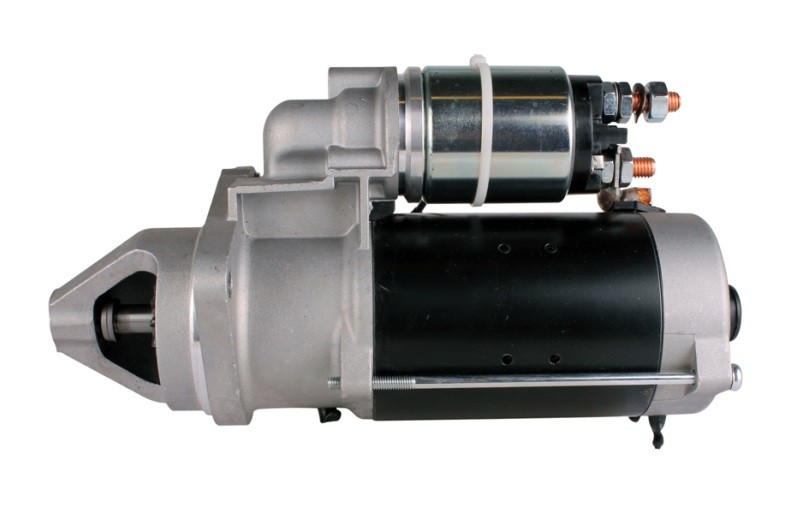
Electric motors, usually referred to as starters, are used for this purpose in most vehicles. Since high friction and compression resistances must be overcome during the starting process, the DC series motor is particularly suitable as a starter motor, due to its high initial torque.

2. Function

Design and function of the starter

A starter motor is usually composed of the following assemblies:

  • Electric starter motor
  • Engaging relay (solenoid switch)
  • Drive-end bearing with single-pinion gear

The electric starter motor consists in principle of a tubular pole housing in which the pole shoes, excitation windings and permanent magnets are housed. The electrical armature with armature winding is situated in this pole housing. The engaging relay, also known as a solenoid switch, is a combination of a relay and solenoid magnet, and is mounted at the top in the drive-end bearing. The single-pinion gear with pinion, free-running roller, engaging lever, carrier and in-line spring is situated in the drive-end bearing.

Function

The engaging relay is actuated when the motor is started via the ignition lock. The flow of current in the pull-in and hold-in winding attracts the relay armature. This actuates the engaging lever and pushes the carrier unit with pinion and freewheel against the ring gear of the engine flywheel. Once the pinion is fully engaged, the contact bridge in the engaging relay completes the main circuit to the starter motor. The starter is switched on and turns.

3. Symptoms

Starter faulty

The following symptoms may indicate a fault in the starter if the motor fails to start:

  • No response when actuating the ignition switch
  • The starter "clacks", but does not engage
  • The starter audibly turns, but without the motor engaging
4. Cause of failure

Causes of faulty starters

A starter malfunction can have different causes:

  • Electrical connections faulty
  • Solenoid switch (engaging relay) stiff or faulty
  • Electric motor damaged electrically
  • Single-pinion gear, starter pinion or freewheel damaged

Notice

A fault-free supply of power to the starter is imperative for its successful function. The vehicle battery and the positive and ground supply of the starter should be included in the fault diagnostics.

5. Troubleshooting

Testing the starter

Electrical faults in the starter are mainly caused by overloads. This can manifest itself in ground and winding short circuits in the field and armature winding, but sometimes also in the coils of the control elements (solenoid switch). Carbon brushes and collectors are subjected to high loads and are more susceptible to faults than the alternator. While, for example, clamping carbon brushes in the alternator do not cause voltage to arise and thus relieve the alternator, clamping carbon brushes in the starter leads to the formation of significant arcs due to the high currents. These arcs often destroy the collector. A multimeter and a clip-on ammeter are required for troubleshooting. Fault sources (such as the pinion) can, however, also be located through acoustic perception. Please also refer to the technical info: " Ground (31) ".

1

The starter does not turn when the ignition switch is actuated.

Cause:Remedy:
Switch on lighting (low beam).
Lighting weak or not working =
  • Break in the cable or ground connection
  • Insufficient current flow due to loose or oxidized connections
  • Battery discharged
  • Alternator faulty
  • Check battery cables and connections
  • Clean battery poles and terminals
  • Electrically secure connection between starters
  • Connect battery and ground
  • Measure battery voltage
  • Check battery, if necessary charge or replace
  • Check alternator
Solenoid switch does not energize:
Bridge terminals 30 and 50 on the starter,
Starter runs / engages =
  • Ignition switch faulty or
  • Break in the cable
  • Replace ignition switch
  • Repair break
Solenoid switch energizes:
Remove battery cable from terminal 30 on the starter and connect directly to the contact screw below connection terminal 30.
Starter starts up =
  • Solenoid switch contacts contaminated or worn
  • Clean/replace solenoid switch and contacts

2

Starter does not turn when the battery cable is connected directly to the contact screw below connection terminal 30, or the starter turns too slowly, or does not crank the engine.

Cause:Remedy:
Carbon brushes wornReplace carbon brushes
Carbon brushes clampingClean carbon brushes and guides of the brush brackets
Springs not supplied with sufficient voltage. Carbon brushes not contactingReplace springs
Collector contaminatedClean collector
Collector grooved or burnedRefurbish or replace starter
Armature or field winding faultyRefurbish or replace starter

3

Starter engages and energizes. The motor only turns jerkily or not at all.


Cause:Remedy:
Battery dischargedCharge battery, check
Poor conductance of electricity due to loose or oxidized connectionsClean battery poles and connections and tighten
Carbon brushes clampingClean carbon brushes and guides of the brush brackets
Carbon brushes wornReplace carbon brushes
Collector contaminatedClean collector
Collector grooved or burnedRefurbish or replace starter
Armature or field winding faultyRefurbish or replace starter

4

Drive pinion does not disengage. Starter engages and energizes. The motor only turns jerkily or not at all.

Cause:Remedy:
Drive pinion faultyReplace drive pinion
Ring gear on the flywheel faultyRework ring gear, replace if necessary

5

Drive pinion does not disengage.

Cause:Remedy:
Pinion or steep thread contaminated or damagedRefurbish or replace starter
Solenoid switch faultyReplace solenoid switch
Return spring worn or brokenReplace return spring

6

Starter continues to run after release of the ignition switch.

Cause:Remedy:
Ignition switch or relay faultySwitch the engine off immediately! Check switch and relay, and replace if necessary

Jak moc vám tento článek pomohl?

Vůbec nepomohl
5
4
3
2
1
Velmi užitečný
Děkujeme za váš názor!

Nesprávný kód Captcha

Nesprávný kód Captcha

Došlo k chybě

Something went wrong

Vyhledávač náhradních dílů
Číslo dílu Ruční identifikace vozidla Univerzální díly
Přední výrobce
Ostatní výrobci
Řada vozidel Zpět
Vozidlo Zpět

Zadejte číslo OE do vstupního pole. Číslo OE obvykle najdete přímo na náhradním dílu nebo v dokladech k vozidlu.

Vyhledávač náhradních dílů
Určete také náhradní díly podle čísel originálních dílů (OE) Podrobné informace o produktu Najděte velkoobchody ve vašem okolí
dummy
Processing Selected Car
Výrobce
Řada vozidel
Vozidlo
Výkon motoru
Objem motoru
Druh paliva
Rok výroby
Kód motoru

Vyberte kategorii:
Zpět
dummy
Sdílejte
Odeslat přes Kopírovat odkaz
URL byla zkopírována do schránky!
Číslo článku
Number
Číslo článku bylo zkopírováno!
Vyhledávání na webu Návod k montáži
Další podrobnosti
Jméno Hodnota
Zobrazit méně podrobností

Váš prodejce
Autoteile Krammer GmbH
dummy
Lechstraße 1-3
68199 Mannheim
Zobrazit mapu

You might also be interested in

TPS sensor
Základní znalosti
TPS sensor – function & troubleshooting
Learn how to check a throttle potentiometer for defects and recognize the most common symptoms.
Doba čtení: 2 minuty
Throttle valve switch
Základní znalosti
Throttle valve switch – function & troubleshooting
Everything you need to know to diagnose and repair the throttle valve switch - helpful workshop tips.
Doba čtení: 2 minuty
Camshaft position sensor
Základní znalosti
Camshaft position sensor - function & troubleshooting
Learn all about the function and testing of the camshaft sensor and possible symptoms of a defect.
Doba čtení: 2 minuty
Accelerator pedal sensor
Základní znalosti
Accelerator pedal sensor – function & design
Important tips for checking the accelerator pedal sensor and rectifying defects - practical knowledge for your workshop.
Doba čtení: 3 minuty
Injection nozzle/injection valve
Základní znalosti
Injection nozzle/injection valve – Function & checks
Find out how to diagnose a defective fuel injector and replace it in the workshop.
Doba čtení: 6 minut
Základní znalosti
Checking the exhaust gas temperature sensor
Step-by-step instructions for testing the exhaust gas temperature sensor - shown on the VW Passat 2.0 TDI.
Doba čtení: 3 minuty
Idle speed controllers / idle speed actuators
Základní znalosti
Idle speed controller & actuator - function & check
Everything you need to know about testing and troubleshooting idle speed regulators: function, typical symptoms and repair tips for your workshop.
Doba čtení: 3 minuty
Intake-air temperature sensor
Základní znalosti
Intake-air temperature sensor - checking & faults
Discover how to check the intake air temperature sensor for defects and how to replace it efficiently.
Doba čtení: 3 minuty
What is a lambda sensor?: Comprehensive technical information
Základní znalosti
Lambda sensor testing and troubleshooting
Find out how to check and measure lambda sensors - with step-by-step instructions for fault diagnosis.
Doba čtení: 14 minut
Air-mass sensor
Základní znalosti
Air-mass sensor - Function & troubleshooting
Learn how to check a mass air flow sensor, detect defective sensors and replace them professionally.
Doba čtení: 2 minuty