Hydraulic steering pump: function and repair instructions

The pump generates the hydraulic pressure required by the power steering system to make the vehicle easier and more comfortable to steer during driving. When the engine is running and the steering wheel is in the "straight ahead" position, the pump constantly conveys the hydraulic oil through the steering and back again into the expansion tank.

Important safety note

The following technical information and practical tips have been compiled by HELLA in order to provide professional support to vehicle workshops in their day-to-day work. The information provided on this website is intended for suitably qualified personnel only.

1. Interesting facts

Design and function

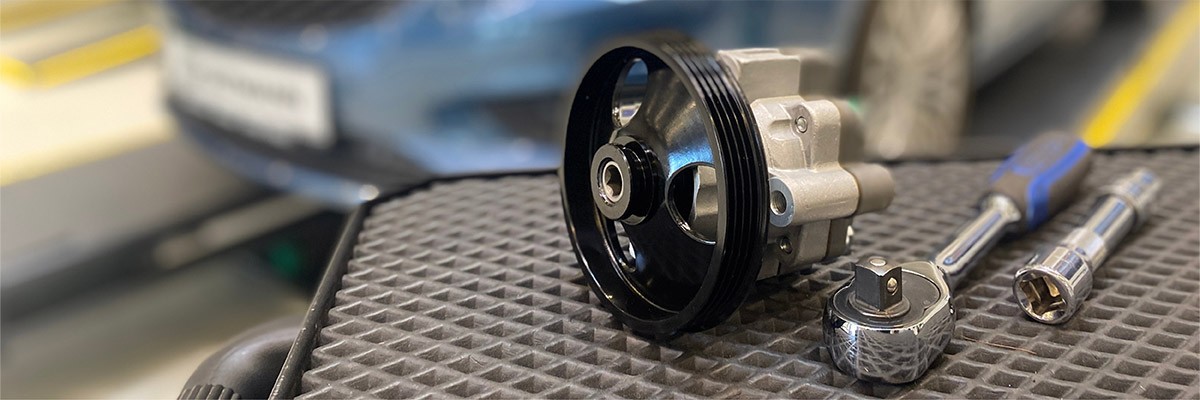
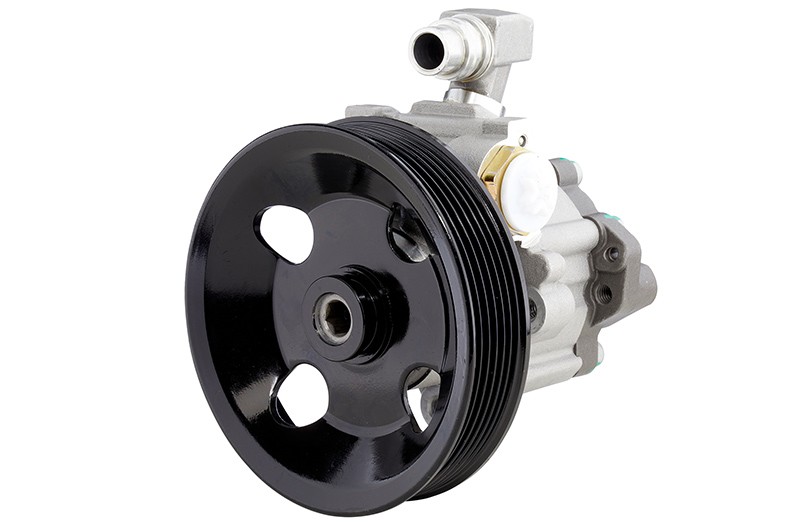
The mechanical hydraulic steering pump, ( Fig. 1 ) also called servo pump, power steering pump or hydraulic pump, is driven by the vehicle engine via a V-belt. The pump generates the hydraulic pressure required by the power steering system to make the vehicle easier and more comfortable to steer during driving. When the engine is running and the steering wheel is in the "straight ahead" position, the pump constantly conveys the hydraulic oil through the steering and back again into the expansion tank. When a steering movement is performed, the volume flow is diverted into the operational range of the power steering and pressure is built up in the system. When the wheel is turned to full lock, the return is blocked and the maximum system pressure for steering assistance is achieved. In some cases, this steering assistance is also perceived by the driver as the result of a whistling sound heard during manoeuvring.

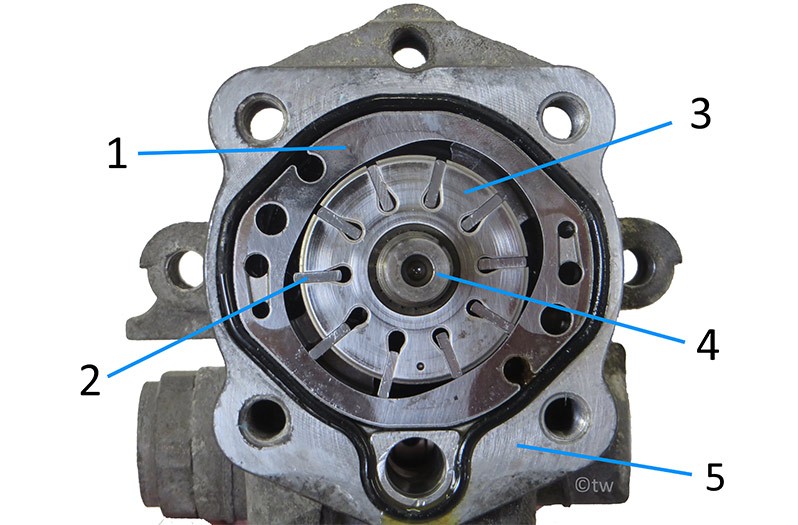
The functioning of a steering pump is based on the rotary vane compressor principle. The rotary vane pump, sometimes called a vane pump ( Fig. 2 ), is a positive displacement pump, which is designed for suction and pressure tasks. The pump contains a rotor that is off-centre to the pump chamber. One or several movable slides (vanes) can be incorporated in this rotor. The belt drive enables the pump shaft and thus the rotor to be rotated. The movable slides are pressed against the inner wall of the pump chamber by means of the centrifugal force and the pressure building up and they seal the cells. The result is that the hydraulic oil in the cells, which are formed by the housing wall and by two slides each, is displaced from the suction side to the pressure side. This change in the chamber volume generates suction pressure causing oil to be sucked in from the expansion tank via the hydraulic pipe system of the hydraulic steering by the steering pump. The volume flow of the pump increases proportionally with the engine speed. In order to reduce the steering assistance at higher driving speeds or pump speeds, the volume flow is regulated via a flow control valve.

Installation position in the vehicle
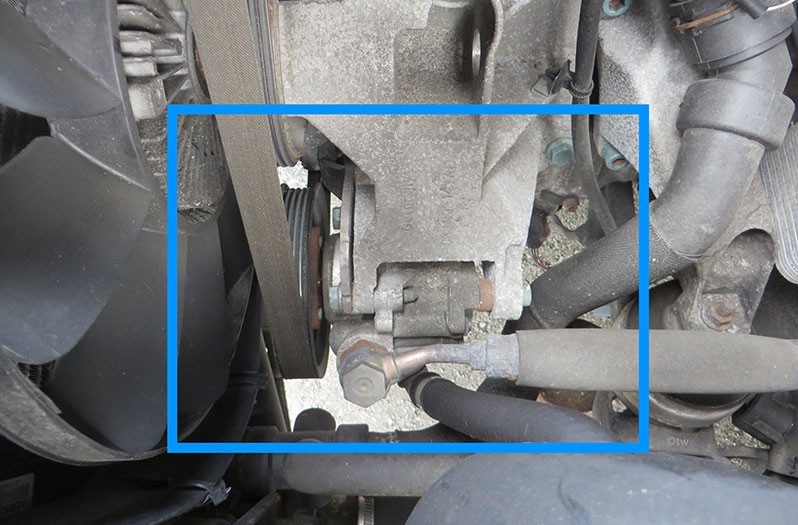
In most cases, the steering pump ( Fig. 3 ) is installed directly at the side of the engine. Depending on the drive belt concept, the pump is driven mechanically with a separate V-belt or via the unit belt

2. Diagnostics

Causes of failure and symptoms

A fault in the hydraulic pump can manifest itself as follows:

  • Sluggish steering
  • Grinding, rasping or jarring pump noises
  • Oil leakage at the pump housing
  • Foaming in the expansion tank

The following causes can be responsible for any defects on the pump:

  • External mechanical damage to the drive or housing
  • Internal damage caused by contamination or metallic abrasion in the steering system
  • Insufficient lubrication caused by leaks in the steering system - pump has run dry
  • Thermal overload caused by hydraulic oil which is too old or unsuitable
3. Workshop tips

Testing and repairs

When troubleshooting mechanically driven steering pumps, the first thing to look at is the V-belt. In many cases, a defective or insufficiently tensioned V-belt can be the cause of faulty power steering assistance. The hydraulic oil should then be checked for fill level and condition and, if necessary, topped up or replaced in accordance with the manufacturer's instructions. The colour of the Servo oil can also provide some clues. Depending on the vehicle manufacturer's specifications, the oil should have an amber or reddish/pink colour. A brownish or already black colouring indicates heavy contamination caused by abrasion in the steering system. In such a case, the system is to be thoroughly checked and the damaged components replaced.

Repair instructions

Repair instructions

If the power steering pump is to be replaced as part of the repair, please observe the following repair instructions:

  • As the repair work is being performed on the steering system, the pump may only be replaced by trained, qualified personnel.
  • The hydraulic steering system must be checked for contamination and, if necessary, flushed and cleaned before installing the pump!
  • After the pump has been installed, the hydraulic steering system must be refilled, bled or vented, and then checked for any leaks! Only use new power steering oils specified by the vehicle manufacturer for this purpose.

Because of its use in the steering system, the steering pump is one of the safety-relevant components. Repair work that is carried out incorrectly can lead to system failure and to personal injuries!

  • For all repair work performed on the hydraulic steering system, please observe the safety and repair instructions provided by each individual and relevant vehicle manufacturer!
  • If necessary, please use the tools specified by the vehicle manufacturer

Removal and installation instructions

If repairs have to be carried out, we recommend the following general procedures:

Removal instructions

Siphon off the power steering oil from the storage reservoir and dispose of it properly.
Remove the drive belt from the pulley on the pump.
Dismantle the hydraulic supply and high-pressure lines on the pump. Collect and dispose of any leaking oil. Dispose of dismantled seals from the connection lines.
Remove the steering pump by loosening and unscrewing the pump fastening screws.
Check hydraulic lines for condition and damage and replace if necessary.
The hydraulic steering system must be checked for contamination and, if necessary, flushed and cleaned before installing the pump! Replace the system filter.

Before the new pump is installed, the old and new pumps should be compared. If necessary, required components, such as the belt pulley, are to be used and adapted from the old pump to suit the new one.

Installation of the new pump is carried out in the reverse order.

Installation instructions

Clean the flange surface of the pump and also the mounting surface on the motor.
Install the hydraulic steering pump in accordance with the vehicle manufacturer's repair instructions. Please observe most carefully the tightening torque of the screws!
Remove all oil plugs and clean the surfaces in the area of the connection points of the hydraulic lines using a suitable cleaning agent.
Connect the hydraulic lines to the pump. Use new sealing elements for this!
Install the drive belt and tension it in accordance with the manufacturer's instructions.
Fill the storage reservoir right up to the mark with new, hydraulic fluid recommended by the vehicle manufacturer.
Start the engine and allow it to run in idling mode.
Turn the steering wheel slowly from the left full lock to the right full lock several times.
Top up the hydraulic fluid until clean fluid with no air bubbles appears in the storage reservoir from the return line.
Check that the oil level in the storage reservoir reaches the marker line and then replace the cap.
Carry out a test drive and check that the steering system is functioning correctly.

After the pump has been installed, the hydraulic steering system must be refilled, bled or vented, and then checked for any leaks! Only use new power steering oils specified by the vehicle manufacturer for this purpose
Jak moc vám tento článek pomohl?

Vůbec nepomohl
5
4
3
2
1
Velmi užitečný
Děkujeme za váš názor!

Nesprávný kód Captcha

Nesprávný kód Captcha

Došlo k chybě

Something went wrong

Vyhledávač náhradních dílů
Číslo dílu Ruční identifikace vozidla Univerzální díly
Přední výrobce
Ostatní výrobci
Řada vozidel Zpět
Vozidlo Zpět

Zadejte číslo OE do vstupního pole. Číslo OE obvykle najdete přímo na náhradním dílu nebo v dokladech k vozidlu.

Vyhledávač náhradních dílů
Určete také náhradní díly podle čísel originálních dílů (OE) Podrobné informace o produktu Najděte velkoobchody ve vašem okolí
dummy
Processing Selected Car
Výrobce
Řada vozidel
Vozidlo
Výkon motoru
Objem motoru
Druh paliva
Rok výroby
Kód motoru

Vyberte kategorii:
Zpět
dummy
Sdílejte
Odeslat přes Kopírovat odkaz
URL byla zkopírována do schránky!
Číslo článku
Number
Číslo článku bylo zkopírováno!
Vyhledávání na webu Návod k montáži
Další podrobnosti
Jméno Hodnota
Zobrazit méně podrobností

Váš prodejce
Autoteile Krammer GmbH
dummy
Lechstraße 1-3
68199 Mannheim
Zobrazit mapu

You might also be interested in

TPS sensor
Základní znalosti
TPS sensor – function & troubleshooting
Learn how to check a throttle potentiometer for defects and recognize the most common symptoms.
Doba čtení: 2 minuty
Throttle valve switch
Základní znalosti
Throttle valve switch – function & troubleshooting
Everything you need to know to diagnose and repair the throttle valve switch - helpful workshop tips.
Doba čtení: 2 minuty
Camshaft position sensor
Základní znalosti
Camshaft position sensor - function & troubleshooting
Learn all about the function and testing of the camshaft sensor and possible symptoms of a defect.
Doba čtení: 2 minuty
Accelerator pedal sensor
Základní znalosti
Accelerator pedal sensor – function & design
Important tips for checking the accelerator pedal sensor and rectifying defects - practical knowledge for your workshop.
Doba čtení: 3 minuty
Injection nozzle/injection valve
Základní znalosti
Injection nozzle/injection valve – Function & checks
Find out how to diagnose a defective fuel injector and replace it in the workshop.
Doba čtení: 6 minut
Základní znalosti
Checking the exhaust gas temperature sensor
Step-by-step instructions for testing the exhaust gas temperature sensor - shown on the VW Passat 2.0 TDI.
Doba čtení: 3 minuty
Idle speed controllers / idle speed actuators
Základní znalosti
Idle speed controller & actuator - function & check
Everything you need to know about testing and troubleshooting idle speed regulators: function, typical symptoms and repair tips for your workshop.
Doba čtení: 3 minuty
Intake-air temperature sensor
Základní znalosti
Intake-air temperature sensor - checking & faults
Discover how to check the intake air temperature sensor for defects and how to replace it efficiently.
Doba čtení: 3 minuty
What is a lambda sensor?: Comprehensive technical information
Základní znalosti
Lambda sensor testing and troubleshooting
Find out how to check and measure lambda sensors - with step-by-step instructions for fault diagnosis.
Doba čtení: 14 minut
Air-mass sensor
Základní znalosti
Air-mass sensor - Function & troubleshooting
Learn how to check a mass air flow sensor, detect defective sensors and replace them professionally.
Doba čtení: 2 minuty