

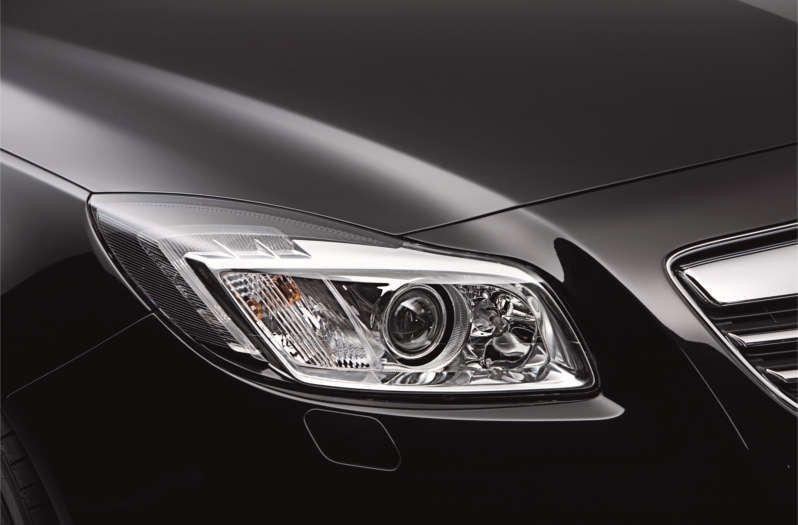
Xenon headlights explained – ballasts, causes of faults, legislation

Xenon headlights provide substantially more light on the road than classic halogen headlamps. They increase safety when it is dark and are now found in almost all vehicle classes. On this page, find out about the structure of xenon headlights and how they work. You can also find out what causes xenon ballasts to fail, how faults can be found quickly, and how dangerous it is to retrofit illegal xenon headlights.

Important safety note

The following technical information and practical tips have been compiled by HELLA in order to provide professional support to vehicle workshops in their day-to-day work. The information provided on this website is intended for suitably qualified personnel only.

1. Function

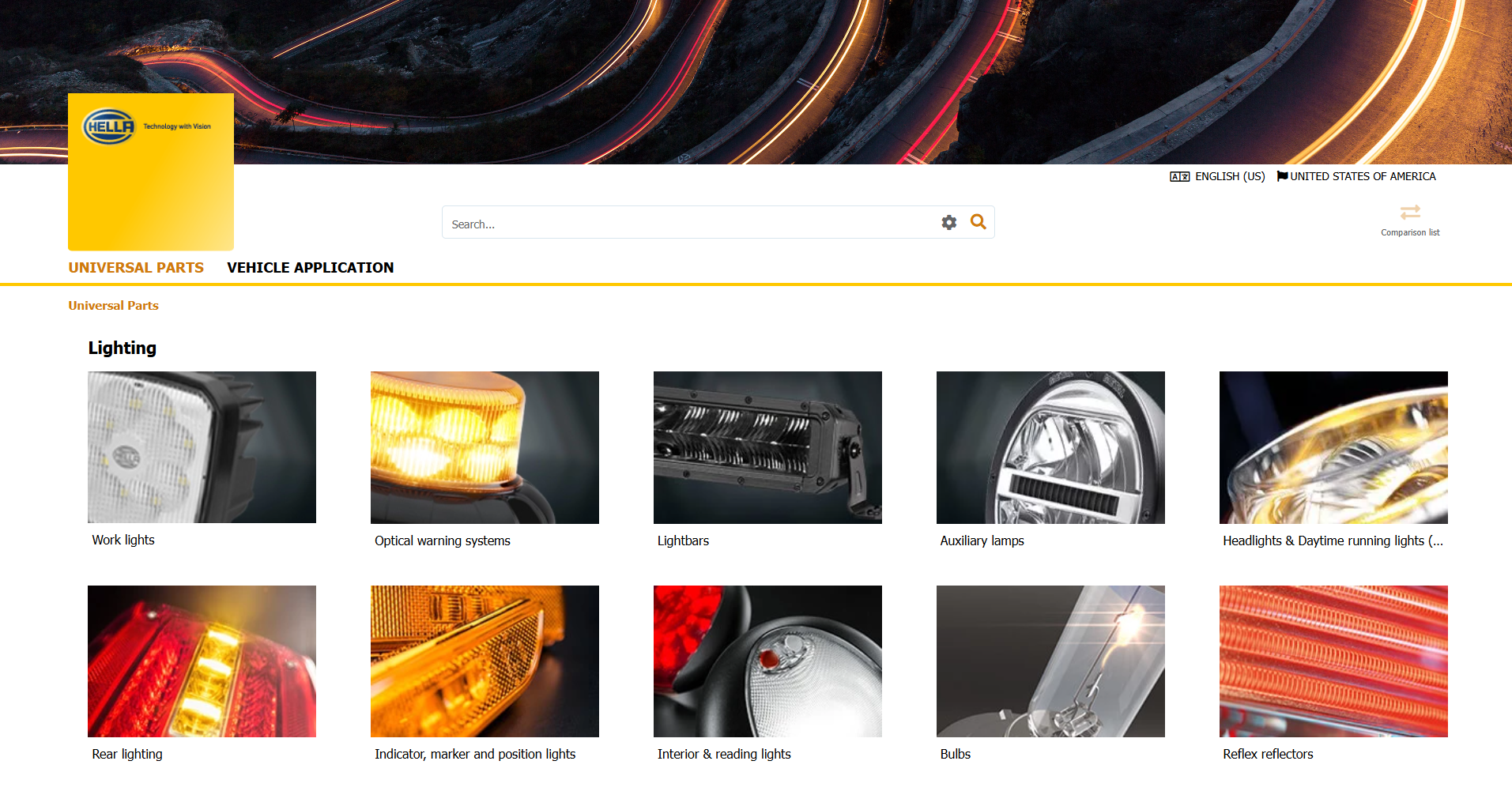
Bi-xenon headlights module

Xenon headlights are comprised of the gas discharge lamp, the xenon ballast, and the reflection and projector-type system. Bi-Xenon means that high beam and low beam are realised by a projection module. This has the advantage that only one ballast is required. This means that two light distributions with a large luminous flux are realised within the smallest installation space.

Function

Through the use of a moveable cover, a purely mechanical switch between the light distributions for high beam and low beam is possible. This means that, aside from the actuating mechanics for the cover, there is no additional outlay for a separate headlamp with its own control electronics. The high beam light also reaches further and the areas to the side of the road are illuminated better.

2. Function

Xenon ballasts

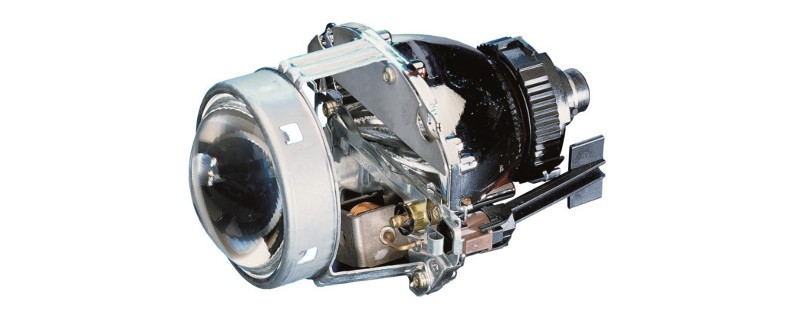
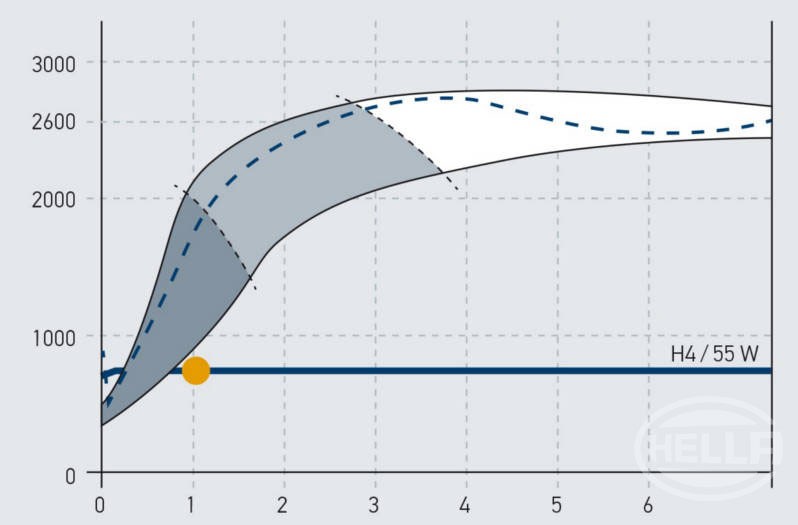
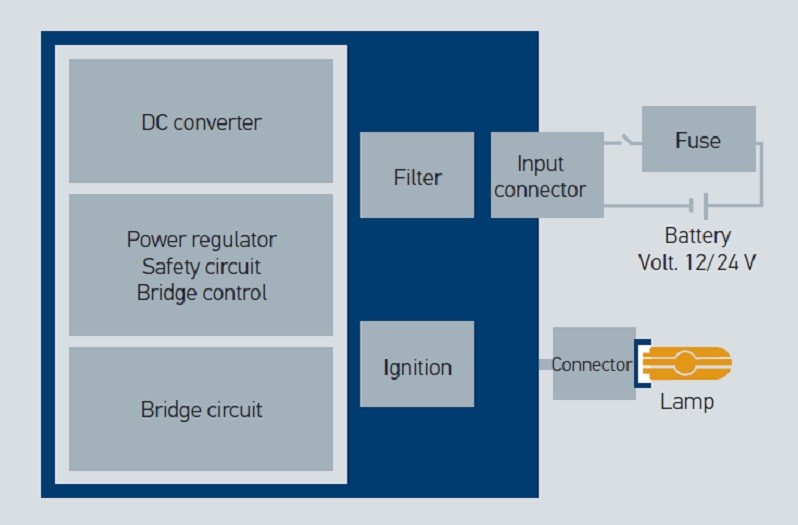
The electronic ballast (E) ignites the inert gas mixture in the bulb with a high-voltage pulse of up to 30 kV (4th generation). It causes a spark to flash over between the electrodes of the bulb. The electronic ballast controls the start-up of the bulb so the bulb reaches its operating phase quickly, and then controls the bulb power to a constant 35 W.

A DC converter generates the required voltage for the electronics and the bulb from the vehicle electrical system. The bridge circuit supplies a 300-Hz alternating voltage to operate the xenon bulbs. Several control and safety circuits are integrated in the device.

Several control and safety circuits are integrated in the device.

The system is switched off within 0.2 seconds in the event of:

  • A missing or faulty burner
  • Damaged wiring harness or bulb part
  • Differential current (fault current) greater than 30 mA; the switch-off time becomes shorter the greater the differential current

To protect the ballast electronics, a counting circuit ensures that a faulty bulb is only ignited seven times. After this, it is switched off.

If the cable connector is removed during operation, the voltage connections are practically voltage-free (< 34 V) after < 0.5 seconds, meaning that there is no immediate danger of electric shock should the warning notice not be complied with.

Properties and differences of the 3rd / 4th generation compared to the 5th / 6th generation

Features3rd generation4th generation5th generation6th generation (Xenius)
BurnerD2D2D1D1 / D3
Internal igniterX
External igniterX
Filtered and shielded versionX
Fully shielded systemXX
Longer cable possibleX
Improved ignition reliabilityX
Laser-welded housingXX
All AFS functions integratedX
LIN communicationX

Ignition module

  • The different versions meet various limit values in terms of electromagnetic compatibility.
  • The main differences between the 3rd and 4th xenon generations are an igniter with or without metal shielding and the cable group between the ballast and the igniter which either features shielding or does not have it.
3. Cause of failure

Faulty xenon ballast

A faulty ballast results in the complete failure of the headlamp.

Causes of failure of the ballast include:

  • Lack of voltage supply
  • Lack of ground connection
  • Faulty electronics in the device
  • Internal short circuits
4. Troubleshooting

Checking the xenon ballast

  • Check whether the ballast attempts to ignite the bulb when the light is switched on. The ignition attempts can be clearly heard in the vicinity of the headlamp. If the ignition attempts are unsuccessful, the xenon bulb should be tested by using the bulb from the other headlamp.
  • If no ignition attempt is carried out, the fuse should be checked.
  • If the fuse is OK, check the voltage and ground supply directly on the ballast. Voltage must be at least 9 Volts.
  • If the voltage and ground supply, as well as the xenon bulb, are OK, the cause of the fault is a faulty ballast.
5. Note

Retrofitting xenon headlights – illegal retrofitting

Xenon headlights look sophisticated and provide the vehicle with a top-class feel. This causes some drivers to upgrade their vehicles with xenon lights. They buy a set with cables, xenon light sources, and ballast, remove the halogen bulb from the headlamp, saw a hole in the cover cap, insert the xenon bulb into the reflector, connect the electronic ballast with the vehicle electrical system, and the xenon headlight is finished. But beware! This procedure endangers other road users because of extreme glare and is illegal: The general vehicle certification is rendered invalid, and insurance protection is restricted. Only complete, type-approved xenon headlight sets including automatic headlamp leveling and headlamp cleaning systems are legal.

6. Useful information

Retrofitting xenon headlights – legal foundation

In Europe, only complete xenon headlight systems may be retrofitted. These comprise a set of type-approved headlamps (with identifier E1 on the cover lens, for example), automatic headlamp leveling and a headlamp cleaning system (regulation as per ECE regulation R48 or compliance with national regulations).

Every headlamp is granted its design approval together with the light source (halogen or xenon) used for operation. If the light source is replaced by a different light source that has neither been granted type approval nor has been provided for in the design approval of the headlamp, the design approval is no longer valid, thus invalidating the general vehicle certification (§ 19 StVZO, section 2, clause 2, no. 1). Driving without general vehicle certification leads to restrictions in insurance protection (§ 5, section 1, no. 3 KfzPflVV, German compulsory insurance directive). Those who sell such lighting equipment which has no type approval have to be prepared for damage claims by buyers, too. Because when the seller passes on these parts, they not only guarantee that these may be used for the intended purpose, but they also possibly take over responsibility for the risk of damage as well – to an unlimited amount.

Technical background

  • High glare values: Measurements in the lighting laboratory have shown that the active light distribution of a headlamp which was developed for halogen bulbs and is now operated illegally with a xenon light source no longer corresponds to the values calculated originally in any way.
  • In the case of reflection systems, glare values were measured which exceed the permissible limit values by a factor of up to 100.
  • The headlamps of these vehicles then no longer have a cut-off line and can also no longer be adjusted. The glare values correspond to those of high-beam headlamps. This endangers other road users massively.

Jak moc vám tento článek pomohl?

Vůbec nepomohl
5
4
3
2
1
Velmi užitečný
Děkujeme za váš názor!

Nesprávný kód Captcha

Nesprávný kód Captcha

Došlo k chybě

Something went wrong

Vyhledávač náhradních dílů
Číslo dílu Ruční identifikace vozidla Univerzální díly

Přední výrobce
Ostatní výrobci
Řada vozidel Zpět
Vozidlo Zpět

Zadejte číslo OE do vstupního pole. Číslo OE obvykle najdete přímo na náhradním dílu nebo v dokladech k vozidlu.

Vyhledávač náhradních dílů
Určete také náhradní díly podle čísel originálních dílů (OE) Podrobné informace o produktu Najděte velkoobchody ve vašem okolí
dummy
Processing Selected Car
Výrobce
Řada vozidel
Vozidlo
Výkon motoru
Objem motoru
Druh paliva
Rok výroby
Kód motoru

Vyberte kategorii:
Zpět
dummy
Sdílejte
Odeslat přes Kopírovat odkaz
URL byla zkopírována do schránky!
Číslo článku
Number
Číslo článku bylo zkopírováno!
Vyhledávání na webu Návod k montáži
Další podrobnosti
Jméno Hodnota
Zobrazit méně podrobností

Váš prodejce
Autoteile Krammer GmbH
dummy
Lechstraße 1-3
68199 Mannheim
Zobrazit mapu

You might also be interested in

Adjusting and replacing LED headlamps
Základní znalosti
Adjusting and replacing LED headlamps
Step-by-step instructions for adjusting and changing LED headlights on the Mercedes Benz W212 - with video.
Doba čtení: 9 minut
Signal lights in cars
Základní znalosti
Car indicators & signal lights: regulations, faults, tests
A general guide to headlight adjustment - with video and tips on optimising light distribution for your workshop.
Doba čtení: 6 minut
Golf 6 rear combination lamp encoding
Základní znalosti
Golf 6 rear combination lamp encoding
Everything you need to know about coding LED combination rearlights on the Golf 6, including installation instructions and adapter cable production.
Doba čtení: 4 minuty
Headlights
Základní znalosti
Headlight lens components, types & regulations
Comparison of the four most important headlamp systems, including regulations for vehicle lighting - knowledge for the vehicle workshop.
Doba čtení: 10 minut
SSL | HD Matrix LED lamps: Troubleshooting
Základní znalosti
SSL | HD Matrix LED lamps: Troubleshooting
Find out how SSL-HD-Matrix LED headlights are constructed and how they communicate in the vehicle, plus service and repair tips.
Doba čtení: 9 minut
Headlamp cleaning system
Základní znalosti
Headlamp cleaning system: Faults, testing
Find out all about headlight cleaning systems, how they work, common causes of failure and repair tips.
Doba čtení: 4 minuty
Xenon and headlight bulb replacement
Základní znalosti
Xenon lamps and headlight bulb replacement
Instructions for changing low beam and xenon lamps in various vehicle types - for the vehicle workshop.
Doba čtení: 3 minuty
Condensation in headlight
Základní znalosti
Condensation in headlight – troubleshooting
Problems with moisture in the headlight? We will show you how to find the cause and fix the problem professionally.
Doba čtení: 5 minut
High-beam assist
Základní znalosti
High-beam assist – basic principles
The high beam assistant: Function, adjustment and how it enables glare-free driving - ideal for workshops that advise professionals.
Doba čtení: 6 minut
Adaptive headlights
Základní znalosti
AFS headlights: Adaptive lighting system explained
Discover how AFS headlights work and what you need to know about the Advanced Frontlighting System.
Doba čtení: 5 minut