Repairing brakes: Important information for vehicle workshops

Important safety note

The following technical information and practical tips have been compiled by HELLA in order to provide professional support to vehicle workshops in their work. The information provided on this website is intended for use by suitably qualified personnel only.

1. Basics

Professional brake disc repairs - What you have to pay attention to

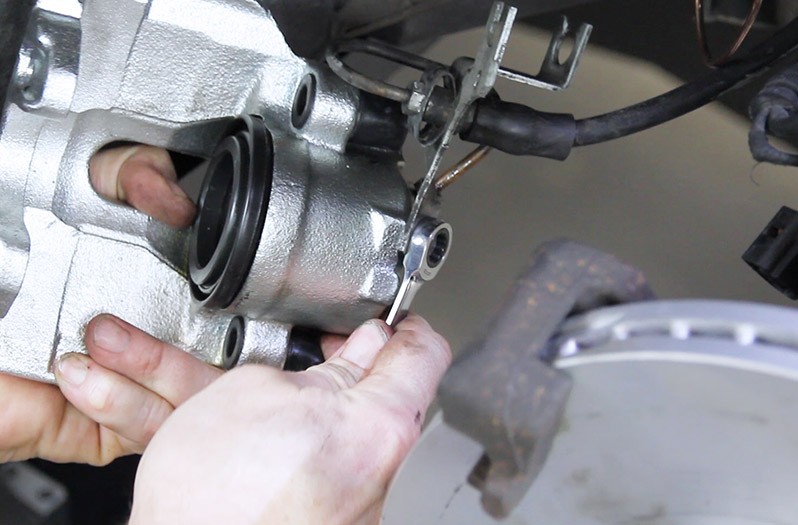
    • Before installation, compare the new spare parts with the parts you have removed.
    • Brake discs should always be replaced in pairs and should always be equipped with new brake pads.
    • Before mounting a new brake disc, the wheel hub should be metallically bright, flat, and free from burrs. It must then be preserved using a suitable spray oil.
    • A proper repair includes the replacement of all accessory parts, such as guide plates or screws. Please always use all parts provided.
    • Brake calliper shafts must be clean and rust-free, and the brake calliper guides must run smoothly.
    • Use only metal-free brake paste on the contact points between the brake pad and brake calliper. Avoid excessive greasing.
    • Components should be clean, should operate smoothly, and should be greased correctly in order to guarantee that the brake system functions properly and to prevent unnecessary noise.
    • In order to prevent damage to the wheel suspension or wheel hub, rough mechanical handling must be avoided when removing and installing brake components.
    • For correct assembly, always use brake-specific tools or, if necessary, special tools. Observe the prescribed tightening torques!
    • Since new brake discs and brake pads first need to adjust to one another, the brake system must be run in immediately following the repair. Comply with the vehicle manufacturers’ run-in instructions.
2. Basics

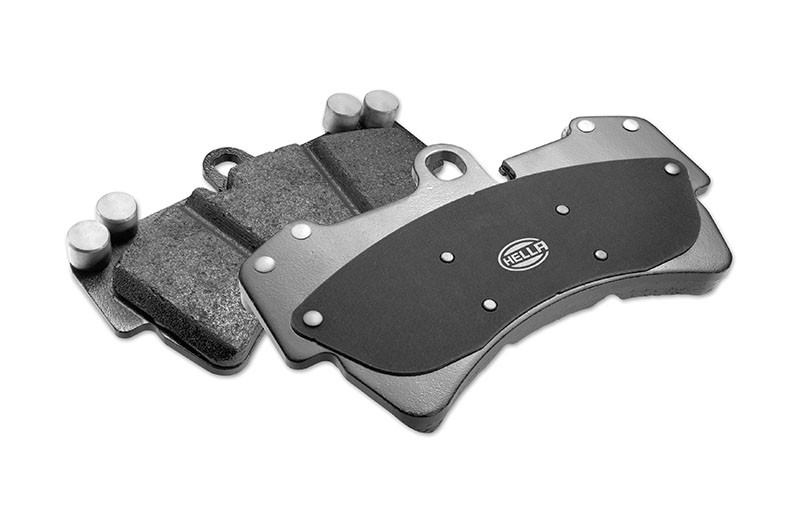
Brake pad design

1. Steel pad base plate

The pad base plate is individually adapted to the requirements of the relevant brake system with regard to the quality, strength and tolerance. Its task is to dissipate temperature and to guide the pad in the brake calliper. A powder coating enables the base plate to be given reliable corrosion protection.

2. Pad adhesives

Specially developed adhesives with a phenol resin base permanently join the brake pad to the base plate and ensure a high shearing strength.

3. Intermediate layer

The intermediate layer, also known as an underlayer, ensures adhesion between the friction material and the adhesive. This improves the hardness, minimizes the risk of cracking, and adds to the comfort features of the brake pad in general.

4. Friction material

The friction material has a very demanding job to do, and is therefore precisely tailored to meet the needs of the relevant field of application.

5. Secondary measures

Various damping measures, or secondary measures, can be implemented on the brake pad to eliminate vibration noises. In addition to the familiar damping plates, a damping lacquer coating may also be used or a special modification may be made to the friction material.

6. Wear indicators

Wear indicators are monitoring devices for detecting when the brake pads need to be replaced. Mechanical displays are riveted onto the base plate. Electronic wear indicators are embedded in the friction material as an additional sensor.

7. Identification

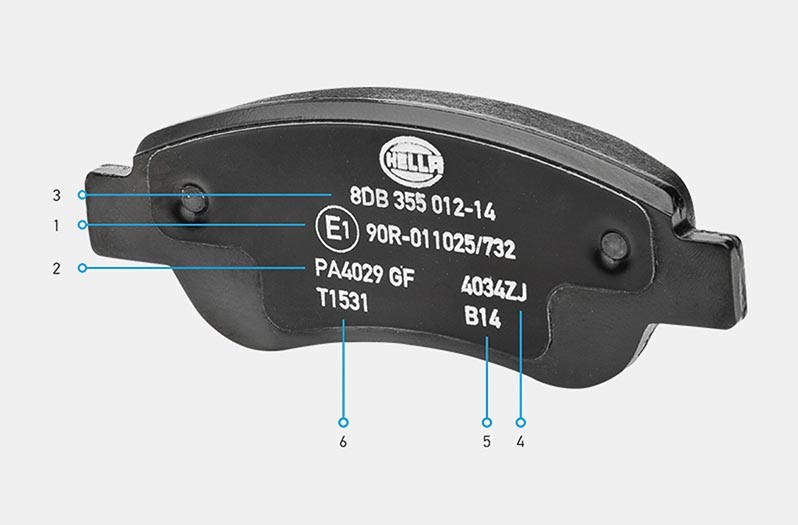
For clear identification, the approved brake pads are marked with an imprint on the rear of the base plate. This ensures that it is always possible to determine where, when, and by whom the brake pad was manufactured.

3. Background information

Brake pad identification

Brake pad identification

    • ECE number
    • PA4029GF | PA (manufacturer) | 4029 (material key) | GF(US friction value code)
    • HELLA part number
    • The batch number defines the unique product composition
    • Environmental code
    • Part number/technical information number
4. Background information

Secondary measures - suppressing vibrations and preventing noise

Braking noise is caused by friction value fluctuations during braking. Secondary measures are intended to suppress high-frequency vibrations and therefore prevent noise. These measures can vary from vehicle to vehicle depending on the structure of the brake system. In some brake pads, several measures may be used simultaneously.

1

Additional noise-damping measures on the rear of the base plate

These include a lacquer coating, textile surface, adhesive film, or additional damping plate.

  • These measures and features further improve the braking effect and driving comfort
  • Adhesive film also secures the brake pad in its operating position and prevents misalignments and noise

2

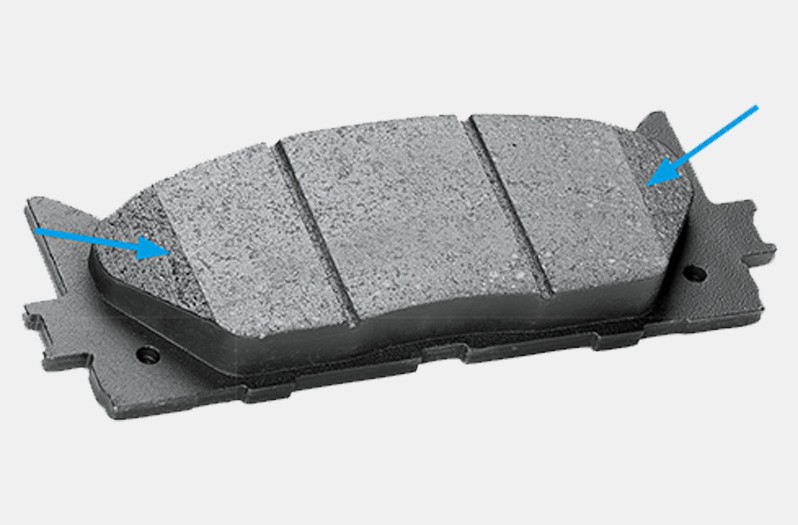
Chamfers

Chamfers are tapers in the friction surface individually developed for each brake pad. The final contour of the chamfer is determined through extensive driving tests as well as on test stands.

Task:

  • Improve the transition between brake pad and brake disc - Sharp edges are avoided
  • Reduce vibrations and noise when initiating the braking process - Due to the changed contact surface on the brake disc, the pressure on the brake pad increases even at low speeds

3

Weights on the brake pad

An additional damper weight mounted on the brake pad increases the overall mass of the component, thus lowering its resonant frequency. Depending on the configuration and position of the weight, this vibration damping can be used for either targeted noise reduction or complete noise elimination. The design of the weight may vary depending on the vehicle manufacturer and the brake system.

4

Slots in the brake pad

Depending on the size and shape of the brake pad, cracks may form in the friction lining as a result of temperature-based expansion. Slots are milled into some brake pads to prevent these cracks. These also reduce noise and hold brake pad wear particles.

5

Directional brake pads

These brake pads are adapted to the installation position in the brake calliper and the running direction of the brake disc through special secondary measures such as chamfers or damping plates. A crescent-shaped recess on the rear alters the press-on position of the piston-side brake pad. This reduces noise and improves the comfort characteristics. The running direction is indicated by an arrow. Special installation instructions are provided for the respective brake pads.

Cât de util ți se pare acest articol?

Nu este deloc util
5
4
3
2
1
Foarte util
Succes

Captcha incorectă

Captcha incorectă

Eroare

A apărut o eroare

Căutare piese de schimb
Nr. OE Identificarea manuală a vehiculului
Cei mai importanți producători
Alți producători
Seria de vehicule Înapoi
Vehicul Înapoi

Introduceți numărul OE în câmpul de introducere. De obicei, numărul OE se găsește pe piesa de schimb însăși sau în documentele vehiculului.

Căutare piese de schimb
De asemenea, identificați piesele de schimb cu numerele OE Informații detaliate despre produs Găsiți distribuitori en gros în apropierea dumneavoastră
dummy
Processing Selected Car
Poducători
Seria de vehicule
Vehicul
Puterea motorului
Cilindreea motorului
Tipul de combustibil
Anul de construcție
Codul motorului

Alegeți categoria:
Înapoi
dummy
Distribuie
Trimite prin Copiază linkul
Adresa URL a fost copiată în clickboard!
Numărul articolului
Number
Numărul articolului a fost copiat!
Căutare pe internet Instrucțiuni de montare
Mai multe detalii
Denumirea produsului Valoare
Mai puține detalii

Dealerul dumneavoastră
Autoteile Krammer GmbH
dummy
Lechstraße 1-3
68199 Mannheim
Afișează harta